
The 2nd Dimension

Saturday, February 02, 2013

Viewing Journal: Kaiji (complete)

Series Overview
Bittorrent Download
Trailer

Rating:
Overall = A
Story = A
Video = B
Audio = B

Journal
Itou Kaiji is a bum who steals car emblems and slashes tires on what seems to be a regular basis. This routine changes one day when he is paid a visit by a man in a trench-coat. Once the two get talking, it seems that the visitor (Calling himself Endou) is a debt collector. The reason for his visit is an unpaid loan which kaiji had previously co-signed for a work-mate (Furuhata Takeshi). The original loan was 30000 yen and once Takeshi had disappeared, the loan then fell on Kaiji. Kaiji is then told of a way to clear the interest compounded debt (which stood at 3,850,000 yen), which involved getting on a boat with others in his position. Once on the boat the debtors would then have to gamble with loaned money, which would end with a few winning, and others getting into deeper debt and having to work to pay of their debts. After some coercing kaiji accepts a position on the boat, in order to clear himself and make a bit of money as well... (Source: ANN)
When I first heard about Kaiji, I figured I'd give it a try because I'd always been curious about gambling anime.  I enjoy shows that involve strategy and I figured that a series about gaming would include plenty of it. Kaiji does certainly include much of scheming amongst the players, but there is a lot about it that I did not expect in both style and content, with over-the-top intensity, tears flowing like waterfalls, and possibly the greatest narrator of all time.

Ito Kaiji is both the luckiest and unluckiest person in the world.  He cosigned a loan with a co-worker Takeshi Furuhata as a favor; but unbeknownst to him, the loan was made through the Yakuza; so when Furuhata disappears, the loan sharks turn to Kaiji to collect. As a lazy bum who can barely support himself, Kaiji can't pay up.  But instead of beating him senseless or forcing him into slave labor, they offer him a chance to take part in a clandestine gambling operation that pays huge rewards and could wipe out his debt, but could also put him so deep in the hole that he may never be able to crawl out.  Kaiji accepts, but it's only when he gets to the gambling boat that he learns the first game on which he'll be staking his life: Rock, Paper, Scissors.

As you can probably tell, this is not your run-of-the-mill World Championship Poker type of gambling.  Each of the six types of games played throughout the show's two seasons is deceptively simplistic and familiar.  But each has unique twist and involve a surprising amount of strategy.

As expected, the level of strategic thinking involved in the games is what really started to draw me into the show.  The rules force the characters to weigh their options with their goals and come up with creative solutions to their problems, including building alliances with other players to gain the upper hand.  It's the anticipation and unveiling of the players' techniques and waiting to see if it actually works that give the show much of it's dramatic impact. But Kaiji fails as much as (or maybe more than) he succeeds especially because his foes don't necessarily have the same moral code or level of loyalty that Kaiji strives to maintain.

All of these factors: the stakes he is playing for, the questionable alliances he makes with others amid competing stategies, and the unpredictable nature if the games themselves, all swirl together to make some of the most dramatically intense moments I've experienced in anime. The level of risk Kaiji takes on becomes greater and more immediate to the point where he eventually is in danger of being maimed or outright killed if he fails.

And if there is ever any doubt as to the perilous nature of Kaiji's situation; the excitable narrator chimes in to overpower you with an impassioned speech describing exactly how much Kaiji is freaking out of the situation, and backing it up with fiery visual analogies. What drives the point home is not just what he says but how he says it. He doesn't scream, but he pushes his voice to the limits so you can just imaging him getting red-faced and sweaty and delivers his epic descriptions.  His awesomeness is as much what makes this show great as anything, as he blasts away any remote sense subtlety in the drama.

The strangest thing is that beyond all of this craziness, the themes that the show explores make it surprisingly relevant: that being the control that money has over our lives. I'm not really purposely analyze symbolism in a story, but as I watched I kept thinking that the key player in this story was the almighty dollar. Those that had it had supreme power over those that did not. And each game seems to explore the different effects that money has on people including greed, obsession, sacrifice, and the seemingly impossibility of succeeding over the rich. A huge part of what drives Kaiji and makes him successful is his persistent will to survive. Since money is inseparably tied to survival, he will do anything to get it, even sacrifice his physical well being. 

Now, as much as I loved this show, it did have one small annoyance: a little thing called...the entire second season. It was mercilessly drawn out, DBZ-style (not that I've ever watched DBZ, but I've heard the jokes). I usually take notes after watching an episode, and for the first season I would write up a good paragraph for each, but in the second season I could get away with writing maybe a sentence or two.  That's because there would usually be only one plot development per episode that moved the story forward and the rest of the time characters were just freaking out about the situation. That second season could have probably been cut to half the number of episodes and still had plenty of time to tell the full story. It was almost physically painful that, in a show where you are constantly anticipating what is going to happen next, you have to wait so long for any real developments.  But, still, I watched through it all and think it was well worth it.

The other issue that the show had — again mostly in the second season — was its reliance on deux ex machine to resolve situation, where the author would add something not previously foreshadowed or something based purely on luck that would get Kaiji out of a situation.  I was able to reason that Kaiji gets as much bad luck as he does good luck, so it's just as well that in games based on chance, he would get a break now and then.  But regardless, that didn't bother me much and by the end I thought that everything came to a very satisfying conclusion.

Overall, it is both a mental torture and pleasure to watch this show.  The moments of tension and anticipation are painful but the payoffs, just like in Kaiji's gambling are exceptional.  Highly recommended.

[ For a full list of reviews see the Viewing Journal Archive ]

Thursday, September 13, 2012

Viewing Journal: Redline

Movie Overview
DVD Info
Trailer

Rating:
Overall= A+
Story = A+
Video = A+
Audio = A

Journal
Every 5 years the race called Redline is held at a surprise location revealed shortly before the race begins. This time around it's being held on Roboworld, much to the dismay of Roboworld's militant government which has no intention of allowing the race to proceed. The race has no rules, whoever crosses the Redline first, wins. Sweet JP is a rare breed of racer who prefers retro style and raw power over high tech gadgets and weaponry. Troubled by their involvement with the mob, Sweet JP and his team just want a clean shot at winning the race. Sonoshee McLaren is a skilled and highly competitive rising star in the racing circuit. She beat JP in the last qualifier and caught his eye. Up against lethal hostility from Roboworld's government and their fellow racers, JP and Sonoshee are pushed to their limits in the race for the Redline. (Source: ANN)
Redline has a lot to live up to in terms of expectations.  Clips and trailers teasing its stunning animation have cropped up on Youtube sportatically over the past 5+ years. When it was finally released in the US, some reviews called it this generation's Akira or Ghost in the Shell in terms of sparking people's fascination with Japanese animation and its vast potential.  It was called a throwback to the golden era of anime in the 80's both both because it is completely hand-drawn cell animation and unrestrained narrative.  And that all certainly got me psyched, but is it really even possible to meet that extreme level of expectation?  Apparently it is — and then some.

The story of Redline is like a sci-fi action version of Cannonball Run in that it's about a no-holds-barred race that the authorities are trying to shut down.  This is certainly NOT the type of movie intended to stimulate esoteric introspection or to explore psychological and social themes and philosophies in the way Akira or Ghost in the Shell are.  This is a movie that is meant to get your adrenaline pumping and pull you into the thrill of the race. It's awesome and insane for its own sake, not necessarily because it advances some complex plot. Everything from it's fast pace to it's wild visuals to the intensity of the characters to the anything-goes storyline are all meant to get you to stand up and shout, "HELL YES!" 

First and foremost it's the visuals that bring people in to see this movie. And although the art style, designs and animation are unique and dynamic, it's not so much how it is animated as what is animated. It's not just that things look good, it's the level of detail included in the artwork, and the variety in the character designs, and the way that it shows the technology in action, and how it uses visual techniques to let you feel what the intense speeds that the racers are experiencing.  Like near the beginning when the main character Sweet JP puts a nitro in his car to give it a super boost, you see the nitro work it's way through the car then to the engine and explode in the engine and how that makes the the car blast forward.  And when it does, the way that it shows the car and the character warp and stretch makes you feel the incredible speed.  So much thought was given to every cell in this animation that it demands multiple viewings in order to absorb it all.

But awesome animation alone will only get you so far before you start craving substance to back it up; and Redline — beyond what I had any right to expect — delivers with absorbing characterization, a cool tone, and all-out insanity.  The variety of character designs are supported by just as much variety in their cool, psychotic or zany personalities.  You have the kind of masculine personalities reminscent of Cowboy Bebop where characters are brash or outright violent towards each other but still have a unstated respect or friendship.  Then you also have the hilariously paradoxical misfits like the crying soldier who is trying to kill his former comrades because of some past slight but apparently just wants their attention.  Plus, each character has a history, whether it's implied or directly shown via flashbacks, hinting that there is much more to this world than this standalone story.  It's that subtle depth mixed with characters' outrageous attitudes, interactions, and relationships that give the movie the incredible energy that the visuals alone could never have accomplished.

If I have one real criticism about this movie, it's the ending.  Not that the ending is bad, it's just that there is no time spent on resolution. It's like you reach the hight of the climax and then it cuts off right at that point.  There's no cooling off period, no "afterward"; there isn't even the extra scene after the credits.  Still though, the climax of the movie really is a true high point and well worth it.

This movie was years in the making, and you can really see that all of that time went to use developing not just the animation but the overall story and characters and world in which it takes place.  It's an all-out blast to experience and the kind of thing to pass around to friends because — anime or no anime — this is just too good to keep to yourself. 

Related Reviews:

[ For a full list of reviews see the Viewing Journal Archive ]

Tuesday, August 07, 2012

Viewing Journal: Bleach (episodes 190-214)

Series Overview
Watch It Now
DVD Info
Trailer

Rating:
Overall= B-
Story = B-
Video = B-
Audio = C

Journal
Ichigo returns as— blah blah blah Who cares?
So this was the make or break season of Bleach for me. After close to 200 episodes, the series had gotten so long with so many ups and downs that I decided that I was either going to dedicate myself to watching the series to the end or I was going to give up on it entirely. So the gauntlet is dropped, and the verdict has been made.

And after watching the first few episodes of the "season" (of which the demarmarkation is nothing more than the change in opening animation — and even then, for this season there were two different openings) that verdict was to give up on the series. I remember back when I was watching episode 50 and the current episode in Japan was episode 170 or so, I was thinking, "Man I can't wait until I get caught up because surely awesome things are awaiting me." I thought how much more developed the overarching plot must be and how many mysteries must have finally been answered.

Now that I am well past that point, the plot has certainly come quite a distance and some quetions have been answered — most notable of which is Nell's past and that of her companions. The problem is that even when they do explain stuff, so much new stuff arises to explain the old stuff, that it feels like it's damn near impossible to ever get any closure to the series; like the series has gotten so convoluted that it will take another 200 episodes just to sort it all out.

Plus, there are still those acursed drawn-out fights that are made even more annoying when there are multiple occurring at the same time. So even when Kenpachi and the other soul reapers appear in Wako Mundo, the initial coolness is deflated by the frustrating tedium of skipping from one battle to another without any of them seeming to advance; and even when they do advance they never come to a completely satisfactory conclusion. I mean, I love fights as much as the next guy but things get mind-numbingly redundant after the fiftieth time you hear "Why can't you accept it? You can't defeat me!" or the sound of someone gasping as they claim that their enemies' fighting techniques are "impossible" or (my wife's personal favorite) Ichigo calling his opponent a "bastard!"

And while we're talking about annoying people; I have to say that Orihime' complete worthlessness as healer is really getting on my nerves. There is one point where Ichigo is fighting and Orihime can't help him because she is captured by an Arrancar (not that she makes any attempt to escape). But even when the Arrancar is gone, she STILL doesn't try to heal Ichigo. She just keeps repeating "Oh, Ichigo! Ichigo!" over and over in annoyingly melodramagic fashion so I'm thinking, "If you're so fucking concerned then heal the guy, you worthless bitch!" This is the ire that Bleach has drawn from me.

So at about episode 205 I had decided to completely abandon the series, but still figured I would finish up the "season" for the sake of writing this review.

Then the flashback happened.

Well, it wasn't so much a flashback as an arbitrary shift backward in time to when the soul reaper squads were in their formative years. And God help me but there was actual character and plot development not to mention improved animation. Now instead of constant battles, there is a constitant concentration on story as if the writers had been stalling this entire time to put together a complex set of events to explain the motivations behind everything that had happened thus far. It was actually good — even fascinating.

In this new storyline things take a dramatic shift with characters in entirely different roles. It was great because it brought so much of their personalities into a new light and upturned many presumptions I had about many of them. We also learn a lot of background info potentially explaining Ichigo's hollow mask, as well as many of the characters' origins. It's annoyingly good to the point where it seriously made me reconcider my vow to abandon the series.

But at the same time, many of my previous complaints were still present. For instance, there are too many characters and back stories for the show's own good. It still seems like we'll never get any closer to resolving the overarching plot because it gets dragged out with the addition of more characters, backstories, and characters within backstories.

Of course, nothing good lasts forever. The last two episodes in this collection are ridiculous filler. Essentially it's a blatent parody on super hero teams like Gatchaman / Battle of the Planets. I guess the fact that it is so silly gives it some entertainment value, but the goofy tone is jarring after the serious storytelling of the previous episodes. It's those stupid filler episodes that pop in like a sniper shot to the head at the most unexpected moments that really put me off to this series.

Ultimately, it's "one bitten twice shy" for me. I've gotten my hopes up way to often, only to be teased into oblivion. And so my final conclusion was to stop watching after this season.

And with that decision comes my final farwell. There's certainly something to be said for Bleach because it's the longest anime I've ever watched, beating out Ruroni Kenshin by double. I mentioned how back at episode 50, I had such high hopes for the series; and even now that attitude has remained, especially since the series ended back in March with episode 366. But even it if does to get better, there are so many other shows out there that I could be watching, that dedicating so much time to a single one just doesn't seem worth it.

Related Reviews
[ For a full list of reviews see the Viewing Journal Archive ]

Thursday, July 12, 2012

Viewing Journal: Eden of the East (TV, Movie 1 & Movie 2)

Series Overview
Movie 1 Overview
Movie 2 Overview
DVD Info
Trailer

Rating:
Overall= B
Story = B
Video = A+
Audio = A

Journal
On November 22, 2010 ten missiles strike Japan. However, this unprecedented terrorist act, later to be called as "Careless Monday," does not result in any apparent victims, and is soon forgotten by almost everyone. Then, 3 months later... Saki Morimi is a young woman currently in the United States of America on her graduation trip. But just when she is in front of the White House, Washington DC, she gets into trouble, and only the unexpected intervention of one of her fellow countrymen saves her. However, this man, who introduces himself as Akira Takizawa, is a complete mystery. He appears to have lost his memory. and he is stark naked, except for the gun he holds in one hand, and the mobile phone he's holding with the other hand. A phone that is charged with 8,200,000,000 yen in digital cash. (Source: ANN)
I started watching Eden of the East because it was directed by Stand Alone Complex and Moribito director Kenji Kamiyama, and was the first of his works not based on an existing manga or novel. He usually works with animation studio Production IG, and the result is some of the most stunning visuals in TV anime. But what really grabs me is his intricately plotted stories, and his strong, multi-dimentional, and intelligent characters. Overall he puts an incredible level of detail into all three parts of his anime: visuals, characters, and story. And for the most part, that is all present in Eden of the East, but even so there was something missing that kept me from being able to fully enjoy this story.

This review is for all of Eden of the East, including the 11-episode TV series and the two movies, King of Eden and Paradise Lost. The story revolves around several people called Seleção who have access to specialized cell phones. They can use the cell phones to call a woman named Juiz who is kind of like a catch-all concierge — she can, one way or another, grant any request in the hopes that it will ultimately lead to that person becoming savior of Japan, whatever that means. The main character is Akira Takizawa — a man who has lost most of his memory who gets involved with a group of people who are involved in the development of a kind of social networking site called Eden of the East. Suffice to say that a hell of a lot of stuff happens across the series and movies with lots of twists and turns. But all of those plot twists are part of a very well thought-out storyline, with lots of details that are integrated into the story so well that it never seems like there is a lot of exposition. This is an anime that you need to pay attention to, and have a solid memory for in order to fully appreciate all the work that has gone into it.

One of the things the most stands out in the show is the number of very specific references to the real-world. It specifically names locations like the White House in Washington DC and specific areas or streets in Japan. And then there are the numbers specific movie references from Taxi Driver to Dumbo. There are so many real-world elements weaved into the story that the over all effect is that it feels like a very solid setting within our world.

The visuals here are also mind-blowing in their level of detail. It reminded me a lot of Voices of a Distant Star director Makoto Shinkai in that you can tell that the settings are drawn directly from real places in both Japan and the US. I have been disappointed with Production IG as of late, but this series shows what they can achieve when they are in top form. And there isn't a lot of difference between the TV series and movies in terms of quality, mostly just in terms of scale.

So the theme here is detail detail detail; but as impressive as all that is, and as much as I genuinely enjoyed much of this series, ultimately I was disappointed with it. The first thing that was that I couldn't figure out the point of the story. And by that I mean that I didn't have a firm grasp on the motivation of the characters, or the purpose of certain events. As I mentioned, I was really hooked on the level of detail, but after a while that fascination waned because I just couldn't see what the purpose of everything going on. I'm not sure if I was a weakness in the storytelling or if I just wasn't paying close enough attention, but by the end of the second movie, I got pretty bored and was just happy to have it be over.

The other thing was that there were no strong characters to latch onto. In Stand Alone Complex and Moribito there were strong and intelligent protagonists; but I just couldn't see that here. The main character was supposed to be this weird guy with a mysterious past, but as I mentioned before, I didn't understand why he did the things he did at all; plus he always had this grin on his face and it seemed like he was supposed to have that Vash the Stampede "I'm acting oblivious but but I'm actually really powerful" grin, but I never got what the power was or what made him any more special than anyone else in the series. After a while I grew really annoyed with him and Saki, the main girl character, who seemed to like him for no reason. Actually, the other characters were more interesting, but got less screen time.

All in all, this was a show that I can recommend for the visuals and the level of details, but I think it becomes weaker as it goes; so that the two movies, as visually incredible as they all are, completely fall flat by the end.

[ For a full list of reviews see the Viewing Journal Archive ]

Friday, July 06, 2012

Viewing Journal: Riki-Oh - The Story of Ricky

Movie Overview
DVD Info
Trailer

Rating:
Overall= A+
Story = D
Video = D
Audio =D

Journal
Sentenced to 10 years for killing a mob boss who caused his girlfriend to commit suicide, Ricky Ho is transferred to a corporate-owned prison, where he must use his martial arts skills to battle a corrupt warden and a group of prisoners known as "The Gang of Four." (Source: ANN)
I first heard about the Riki-Oh movie via an episode of AWO in which they discussed the original manga. They talked about how over-the-top the violence in the movie was, specifically mentioning certain scenes that sounded so crazy that I just had to check it out. But that desire remained unfulfilled until someone at work (the same one who had lent me the live action Devilman movie) offered to lone it to me. By the time I returned it, I had an new found appreciation for movies that are are so horrible in content and quality that they come full circle to become mind-blowingly awesome.

Admittedly, when I started watching the movie and saw some of those initial bloody scenes, I was not impressed. Part of that that was because I had already heard about them from other people, so it killed the surprise factor. But I also think that — as nuts as those scenes were — I'd seen crazier stuff in manga and anime. So sure Riki punches a guy through the stomach; so what? Battle Angel Alita probably did that like twenty times.

But oh how naive I was because things only got more and more crazy from there. I think the real turning point was a the fight scene where Riki gets his arm cut and then proceeds to do a certain trick to stop the bleeding, after which his enemy tries to strangle him in glorious fashion. That was when it was clear this was indeed something that I had never seen before. I'm sure if I saw those scenes in the original manga it would have been amazing enough, but seeing them done in live action without so much as a trace of irony made it completely mind blowing. And the end of the movie with the final fight scene that had so many WTF moments you can't not react to it, convinced me that this was a cinematic classic.

And on the subject of comparing the manga and movie, I've always thought that the main difference between anime/manga and live action was the suspension of disbelief factor. Since anime and manga are already artistically stylized, there's already a layer of unreality to it that allows you to get away with showing fantastic stuff like giant robot fighting one another or super powered school girls beating each other up. But since live action is by it's nature showing showing real actors in real settings, the audience is more likely to compare it to reality. As a result the audience is more likely to dismiss things that are not consistent with how they see the world. It's what I would call a low suspension-of-disbelief threshold; and I'd always considered that a weakness of the live-action medium… until Riki-Oh.

In Riki-Oh, everything is so over-the-top and in-your-face with the unreality of it that the "badness" actually makes it incredible. I'm not just talking about the horrible effects, but the actual story itself. So when Riki trips a guy in the bathroom and he gets impaled on spikes on the floor, it's not just that it's obviously a dummy that fell on the spikes; it's the inexplicability of those spike being on bathroom floor at all. There's no reason for them to be there other than because the director wanted to show a guy's head getting impaled. It's the unapologetic way that the director does what he wants while still keeping a strait face, so you're never sure if the ridiculousness is intentional or not, that makes the movie so much fucking fun. So you'll have a scene where the villian tries to kill Riki by having a ceiling slowly descend on him, but instead of escaping through the gaping hold in the wall, he breaks through the steel bars imprisoning him. That's cinematic gold, people!

I'm really trying to (probably unsuccessfully) avoid going into too many specifics because it's best to go into this movie without too many expectations. In fact, if you do see this and like it I'd suggest springing it on a group of unsuspecting friends. After a hour and a half of bodily explosions, I guarantee that you will be better and closer friends for it.

[ For a full list of reviews see the Viewing Journal Archive ]

Wednesday, June 27, 2012

Viewing Journal: Trava Fist Planet (complete)

Series Overview
Bittorrent Download
Trailer

Rating:
Overall= B
Story = B
Video = A-
Audio = B-

Journal
Ace pilot Trava and his personal mechanic buddy Shinkai, on their way to mark an out-of-the-way planet, pick up Mikuru, a girl with no memory. The three are about to discover that the planet is more than it seems. (Source: ANN)
Trava Fist Planet is a short series made up of four 10 to 15 minute episodes about two "markers" — people who go to new planets and mark them for later exploration. They are trying to earn money to enter the "Fist Planet," a fighting/racing event whose grand prize ranges in the billions. While on their way to their next mark, they stumble upon a woman who has lost her memory, taking her with them to survey the strange and dangerous planet.

The only reason I watched this series was because it's the prequel to Redline, the long-in-the-making movie that looks mind-blowingly awesome but which I still have yet to watch. Trava Fist Planet is not nearly as action-oriented as Redline promises to be, but it is still has plenty of entertainment value due to its clever writing, off-kilter characters and setting, and awesome animation.

What this series lacks in action, it makes up for in snappy dialogue. The two main characters who are made up of the dog-eared Trava and the "lobster man" Shinkai are constantly bantering back and forth in a way that reminds me of Jet and Spike in Cowboy Bebop. The confident Trava is always jibing Shinkai who in turn is hopelessly trying to defend himself. It's the quick, constantly unexpected wit that gives this show tons of personality and a fun, casual tone even when things are at their craziest. The only issue is that at times it can get quiet and a bit boring to the point where I really just wished that something — anything — would happen. But for the most part it is very cool.

Of course, I'm not saying that there is no action in this show or that it is not visually stunning. The designs are done by the same guy who did Dead Leaves and the best episode in the Animatrix, World Record. The character designs have that Aeon Flux elongated-limbs look, and I'm not sure how to describe everything else other than to say that it is extremely unique and awesome. As the story progresses there are some action scenes that get really crazy, especially in the finale and the animation never disappoints throughout. The only major issue I had was with the last fight scene, which ended before we see any real action. Whether that was due to budgetary constraints or was an intentional storytelling device, I'm not sure. But for the most part the animation is phenomenal.

As for the story itself, I would simply describe it as strange but entertaining. The characters are spontaneous, and the planet that the story takes place on is incredibly strange, but even so, all of the concepts in the story are explained well enough that I always understood what was going on.

So overall I'll say that this a very strange show with fun dialogue, unique designs, and a decent amount of crazy action that is well worth watching. Now on to Redline!

[ For a full list of reviews see the Viewing Journal Archive ]

Friday, June 22, 2012

Viewing Journal: Devilman (live action movie)

Movie Overview
DVD Info
Trailer

Rating:
Overall= C+
Story = C
Video = B-
Audio = C

Journal
Akira Fudo is a kind-hearted, shy teenager until one night his best friend Ryo Asuka reveals to him a terrible truth: demons are awakening in our world and mankind is in peril. Assuming the mantle of Devilman, a demon with the heart of a human, Akira fights demons as well as the rising chaos of a panicked human populace. (Source: ANN)
I've been discussing anime and Asian action flicks with someone at work recently and we got to talking about Go Nagai — the legendary creator of such fine offerings as Cutie Honey, MazinKaizer, Violence Jack, and Getter Robo. In the course of the conversation, he mentioned that the live action Devilman was pretty good and he offered to let me borrow it; and since I've been wanting to check out stuff by Go Nagai for a while, I eagerly accepted. But after watching it I can only say that this movie is "okay". There were a few elements about it that I liked and that surprised me, but in general the story was awkward and uneven.

The main issue that I had was that the transitions between plot points was so abrupt. For instance, in the beginning we have the two main characters — the teenage Akira and Ryo, two friends who are both kind of sullen but who are driven to protect each other. There's some good character development in those first few scenes; but then out of nowhere Ryo brings up the fact that his father is in Antarctica with a group of scientists who were digging for a new source of energy when they unintentionally unleashing demons into the world. And with that revelation, we abruptly go from being a somewhat realistic story about a couple kids brooding, to having all of these grotesque demons, two of whom possess Ryo and Akira, transforming them into devils who start fighting each other. Then just as abruptly they go back to being human kids who talking about their fate, wherein Akira decides to use his new demon powers to protect humanity. The fact that there is little to no build up or foreshadowing or any real logical explanation prior to these plot twists makes it seem that the story is being made up as it goes along, despite being based on a pre-existing material.

I think a major reason for these jumps in the story is because it is trying to sum up the event in the manga/anime. I have never seen the Devilman anime or read the manga, but it seemed like there was a lot more to the story than what was being presented in this movie. For instance, I could tell that there was probably more about to the relationship between the devil who possessed Akira — Amon — and the devil who possessed his friend Ryo. And then there's the angelic devil lady who only shows up briefly and hints that she may have been romantically involved with Amon at some point. Unfortunately we don't get that background info or see those relationships develop much more than one or two slight hints, and we never see that devil lady at all after her introductory scene. So I can imagine this movie as being an excellent supplement if you've seen the other versions because you could see the characters, setting, and fights in live action while filling in any plot holes with your knowledge of the anime or manga. But for someone like me, it can be frustrating or downright annoying.

What I actually did like about the movie, which I didn't expect, was its epic scope. It eventually develops into a story involving the entire world, with nation fighting nation and people on the streets killing each other because no one knows who is really a demon and who isn't. It's that decent into chaos and the exploration the darker side of human nature and the breakdown of the social order that I really liked and which I thought really gave the movie substance. The story just keeps on getting bigger and bigger and more insane until the very end when there is an epic fight between the two main characters.

And those action scenes, where devils fight one another, were very cool indeed. I especially liked the parts where you would see one devil strike another and the visual would suddenly shift to a sketchy drawing of the fight and just as abruptly shift back to the real fight. It was a really cool effect and a nice homage to the original manga.

So overall, it was an entertaining story but probably better suited for someone who is already a Devilman fan. I do really want to check out other Go Nagai stuff, but this movie doesn't make me want to start with Devilman.

Related Reviews:
[ For a full list of reviews see the Viewing Journal Archive ]

Friday, June 15, 2012

Viewing Journal: Macross - Do You Remember Love?

Movie Overview
Bittorrent Download
Trailer

Rating:
Overall= B
Story = B
Video = B+
Audio = B

Journal

Made in 1984, Macross: Do You Remember Love is a summary of the events that occured in the Super Diemension Fortress Macross TV series — itself known as the show that was re-cut to make the first part of US TV series Robotech. In this movie version the earth is at war with an alien race known as the Zentradi. The interstellar transforming battle spaceship/robot/city/fortress known as the Macross is on its way back to earth when it crosses paths with a Zentradi fleet. A battle ensues during which one of the Macross' fighter pilots gets lost within the Macross' dark trappings with a pop idol singer Minme. This eventually prompts an unapproved romantic flight among the rings of Saturn, a capture by aliens, a love triangle and various other dramatic and exciting action scenes, in what is probably one of the best series-summary movies I've seen.

Since this is a summary, you do not need to have seen original TV show to watch this movie, but it probably would help. While it does a good job of including all of the elements needed to understand it's self-containted plot, it still feels very much like you are dropped in to the middle of the story. Things happen so suddenly and fast at the beginning, that it can be a little confusing. There's the giant spaceship/city Macross which is trying to return to earth, and you can tell that there is a war going on between Earth and the alien race known as the Zentrans. But why exactly the Macross left earth, where the ship originated, or the details behind how the war between earth and the Zentrans started is skipped entirely. Personally, I have only seen a handful of episodes of Macross and Robotech, but I know enough about the backstory to be able to fill in those blanks. However, those who have no previous exposure to the story can still enjoy this movie as long as they can accept that many questions they have about the backstory may not be answered.

I actually ended up watching this movie twice; and to be honest, the first time I was not crazy about it. Part of the reason for that was because I was confused on exactly where it fit in the Macross continuity. I originally thought it was supposed to be a sequel to it, and it wasn't until later that I realized that is was supposed to be a condensed re-telling of the series. But even beyond that, the story and the characters were just so over-the-top cheesy. I mean, this is a show where giant powerful aliens can be rendered incapacitated after simply seeing a man and woman kiss, and where pop music literally saves the human race. How am I supposed to take that seriously? Then there's the love triangle between Hikaru, Minme, and Misa which seemed totally cliche. I had a hard time empathizing with any of the characters since may of them seemed like stereotypical anime personalities just with amped up melodrama.

The second time I watched it, my opinion was entirely different. Part of that change in attitude was because I understood that this was a re-telling and not a sequel. But the main reason for my shift in opinion was that I knew what to expect, so I was not as distracted by the cheesiness and melodrama and could focus on the details. And that's what really makes this movie so beloved by fans: the details in everything from the characters to the story to the setting and animation. The story itself is complex and has plenty of surprises; and somehow even the over-the-top ridiculousness of the premise lent the movie a certain amount of awesomeness because it is never apologetic about it and if you pay attention to the backstory of the aliens, their reactions to humanity are consistent and understandable (if not reasonable). And even the development and resolution of the love triangle is much more complex than I first thought. The scene where Misa and Hikaru are stranded, and are shown playing house in order to pass the time is especially well done and does a great job of showing their relationship develop. It's that kind of subtle detail that, when you are paying attention to it, really plays off with emotional impact. And despite the condensed story, it never seems rushed or feels like things are being glossed over. Each scene has meaning and contributes to moving the story forward at a comfortable pace.

Then of course there's the detail in the animation. I'm sure a lot of audiences will be turned off by the hand-drawn animation of the 80's, but personally I love that style of animation just because it allows for more creative freedom and spontaneity in the artwork.

So in the end, I did really enjoy this movie. I think that if you can get past some of cheesiness, those who are willing to look will appreciate the detail and craft of the story and animation.

[ For a full list of reviews see the Viewing Journal Archive ]

Wednesday, June 13, 2012

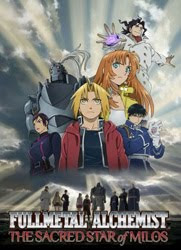
Viewing Journal: Fullmetal Alchemist - Sacred Star of Milos

Movie Overview
DVD Info
Trailer

Rating:
Overall= B+
Story = B+
Video = A
Audio = B

Journal
After a mysterious prisoner with only a few weeks left on his sentence breaks out of prison in Central City, the Elric brothers attempt to track him down. The search leads them to Table City in the southwestern country of Creta, where Alphonse rescues a young alchemist named Julia from the very man they are trying to capture. In the thick of the fight, they literally tumble into Julia's home turf, the slums of Milos Valley, and are embroiled in the grassroots rebellion of her people. (Source: ANN)
Fullmetal Alchemist: The Sacred Star of Milos is a stand-alone story in the FMA universe. It does not build on or effect anything related to the plot of either series (of which there are two alternate versions), but even so it has much of the quality that you come to expect from the FMA franchise. It has the cool alchemic battles and genuine drama; plus, everything from the action to the setting to the story has a grand, epic scale worthy of a theatrical feature. The main characters, Ed and Al, display all the qualities that made us love them in the series: their skills with alchemy, their drive to follow their goals without compromising their principles, and their tendency to inspire those around them. Thankfully, however, this movie is surprisingly lacking in the running gags that were omnipresent in both FMA TV series. So no jokes about Ed being short or about people confusing the armor-clad Al as being the famous "Fullmetal Alchemist."

The one thing that this movie does not have that the series—especially the second series FMA: Brotherhood—does have is the strong supporting cast; as almost everyone in this movie other than Ed or Al is original to this story. Sure, the movie has passionate characters with strong backstories and motivations that supply a powerful emotional impact; but they are not as well-rounded or quirky as the characters of the TV series. Many of the series' supporting characters could carry the show even when the main characters were not around. They have paradoxical aspects to their personalities—the bad-ass woman who boldly leads an army of men, the gentile strongman, the child who is pure evil…the list goes on. But in this movie the characters' personalities are relatively strait-forward, even if some of their superficial aspects (i.e., the bat-people) are not; and it's mostly their reaction to Ed and Al that allows the best parts of their personalities to shine.

So, all that being said, there are two lingering questions about this movie: how will fans of the series like it; and how will those unfamiliar with the series like it. (And I'll follow that up by saying that you could come into this movie after watching either FMA TV series because there is nothing in this movie that is exclusive to either series.)

For the first question, it depends on what you are expecting. If you want to see of your favorite character and your favorite character is someone other than Ed or Al then you will be gravely disappointed. Sure Mustang, Hawkeye, and Winrey occasionally show their faces, but they do nothing of consequence. Even when Mustang joins in the final battle, he does next to nothing to show his powers. Then there's Armstrong who comes on scene to do nothing more than deliver a message to Mustang. It's fairly obvious that the only reason those characters exist in this movie is to give fans something to fawn over. But personally, I would prefer that they not be in there at all instead of wedging them awkwardly in throw-away roles.

For those who have never seen any FMA before, I think they might enjoy the movie quite a bit. The movie does assume you have some prior knowledge from the series regarding alchemy and it's concepts and principles; but I still think that it is simple enough that a non-fan could figure out anything that is not overtly explained. And I also think that it may give those audiences enough of a taste of the series to motivate them to go out and investigate it further.

So overall, I think this is a great movie that is fun and has enough of a taste of the FMA universe to please fans and non-fans alike.

[ For a full list of reviews see the Viewing Journal Archive ]

Wednesday, May 09, 2012

Viewing Journal: Trigun - Bandlands Rumble

Movie Overview
DVD/Bluray Info
Trailer

Rating:
Overall = A+
Story = A
Video = A+
Audio = A+

Journal
20 years after meddling into the bank heist of a notorious robber named Gasback, Vash the Stampede is heading towards Macca City. Rumors say that the legendary thief might appear there causing an enormous influx of bounty hunters in the area who want to collect the $$300,000,000 prize for his head. (Source: ANN)
Remember the old Trigun TV series?  Well, now Vash the Stampede is back and better than ever with large-scale action, great comedic timing, and a dash of drama in this feature-length awesome-fest of gun-blazing greatness.  In terms of it's relationship to the series, I'd compare it to the Cowboy Bebop movie: just another self-contained adventure of the main characters, but probably better than any of the episodic adventures from the actual original series.  The plot is easy to follow and is simple enough to give the characters breathing room to display all of their quirks while still allowing the story and action to keep steaming forward.

It's been years since I saw a Trigun episode, and this movie brings back all the nostalgic joy of the original.  It's pure entertainment that simply makes me happy when watching it.  Pretty much everything is bigger and more awesome, wisely taking the things that were great about the TV series—including the traits of the characters—and enhancing them.  So you have Vash's uncanny ability to use his gun to avoid violence while maintaining a cheery facade, you have Wolfwood's coolness, and you have the insurance girls' frustration with Vash and hilarious dedication to their job.  The effect that Vash has on the other characters, the contrast between his reactions and the situations, the paradox of his being notorious for causing destruction while being goofy and unnaturally skillful, all combined to make for a fantastic ride.  It's also awesome to see the interplay between Wolfwood and Vash again, even if there's not as much casual banter between the two as I would have liked. The new characters—Gasback and Amelia—are not as multidimensional of either Vash or Wolfwood, and are not as interesting by themselves as they are when reacting to Vash, but that was the same for the extraneous characters in the original series.  Even so, they have plenty to offer in terms of bringing the story to life and kick ass in their own way.  

The animation is fluid with incredible art that includes unique character designs—even among the background characters—and the seamless inclusion of computer graphics that allows the animators to do some pretty sweet large-scale action scenes.  Plus there is still the fantastically blistering guitar music as the soundtrack which nicely adds that hard edge to each scene.

I'm not sure if I would say this is good for someone who has not seen the TV series because there is not much explanation given for some concepts, the setting, or the characters.  It's more satisfying as a re-visit for those who are already familiar with the story.  It's got humor, action, relatable and cool characters, drama and all out fun-as-hell pure joy entertainment.  Fans of the original series, and even those who watched it but were not originally fans need to watch this and love it.

[ For a full list of reviews see the Viewing Journal Archive ]
Friday, October 14, 2011

Viewing Journal: Panty and Stocking with Garterbelt (complete)

Series Overview
DVD Info
Trailer

Rating:
Overall= B+
Story = B
Video = A-
Audio = B+

Journal

A company of ghosts has moved into Daten City, taking advantage of human greed. Two angels, Panty and Stocking, are sent from heaven to exterminate them—but in reality they got kicked out for bad behavior. (Source: ANN)

When I first heard that Studio GAINAX was creating a new anime called Panty and Stocking with Garterbelt I conjured up all kinds of preconceived notions about what it would be like and as a result I immediately dismissed it. However, after hearing and reading some reviews, I thought I'd give it a chance. As it turns out, it is not the kind of show I thought it would be, but is exactly the kind of show that I probably should have thought it would be. It's perverted as expected, but it is approached with such a self-aware, ironic, unrestrained and unabashed style that it exudes energy, unpredictability and fun, even if not as much hilarity as I would have liked.

What there is of a plot involves two earth-bound angels named Panty and Stocking. Panty is obsessed with sex and Stocking is obsessed with sweets and each will indiscriminately partake in their obsession anywhere, anytime. Because of their torrid ways, they were kicked out of heaven and sent to Daten City. There they live in a church with their clerical overseer Garterbelt who doles out heaven's orders to fight "Ghosts"—vengeful incarnations of objects or concepts ranging from feces to obesity to high school cheerleaders—that show up around town so the two can hopefully earn their way back into Paradise. The real gimmick of the show, however, is how they fight the ghosts: Each removes their namesake apparel which then transforms—in true magical-girl style—into their weapon of choice: Panty getting a revolver and Stocking getting a katana.

Of course, this is not so much a plot as it is a framework that allows the animators to let their unrestrained libido's run wild by putting the characters in any number of disparate situations, many of which have nothing to do with fighting ghosts. Overall the effect is something like a mix between the shock value of South Park and the fast-paced random energy of FLCL, but without the thematic value or social commentary of either. The show doesn't have the wit or comedic timing to make it laugh-out-loud funny, it's more about getting caught up in the fast-paced random insanity and wanting to see what crazy situation Panty and Stocking are going to get themselves into next and how they are going to get out of it. And while Panty and Stocking themselves have their characteristic wanton desires, the fact that they are so unapologetic and bad-ass transforms that perversion into energy, making for crass humor that is fun and surprising.

Still, without an underlying meaning or direction, that kind of crude, arbitrary storytelling can get tedious and mind-numbingly boring after a while because it seems so pointlessness. Thankfully, things pick up around episode 6 when the main antagonists Scanty and Kneesocks show up. They are essentially the devil versions of Panty and Stocking—complete with their own transformation sequence—and are the first to legitimately challenge the angels, allowing the show to create a bit more of a continuity. It's the first time in the series where the comedy is based more on character interaction and conflict instead of parody or crass humor, bringing a renewed energy to the characters and narrative.

The thing that makes this crass and perverted humor successful is that it is done to such an extreme as to be self-mocking; except, of course, when it's not. The fact is that the show is at times uncomfortable to watch because at one level it's like, "Ha ha . Isn't it so silly that panty is having sex with an entire football team;" but on another level you can tell that the creators are actually getting off on it. The moaning lasts a little too long and sounds a little too genuine, and the aforementioned transformation sequences lingers a little too long in certain places to be considered entirely ironic. Instead it seems like in the midst of all the wackiness, it's attempting to be genuinely titillating. So while you are laughing at the stupidity of the perversion, it suddenly turns the tables so that the audience is actually laughing at itself—or at least at the creators. That could be genius if it was intentional, but I not sure that it is, which is why I say that, while it doesn't ruin the show, it does make those scenes awkward to watch.

Another weird thing is that this show is filled with references to American pop culture. In fact, it seems so tailored to American audience—including all the on-screen text being in English—that if a company dubbed the show into English there would be very little other than the frantic tone that would indicate that it originated in Japan. Even the animation is mostly done in a very two-dimensional, heavy lined, Power-puff Girls type of art; the notable exceptions being the aforementioned transformation sequences and the live-action shots of model ghosts being blown up. But it's the specific references that are omnipresent throughout the series that make it either specifically designed with a US audience in mind, or simply a homage to to the US entertainment industry from an different country's perspective. And while it's fun—if a little strange—to find so many references to things like Sex in the City, the Transformers movie, and Las Vegas when they are integrated into the story well; there are times when the entertainment value and even the general comprehensibility of an episode is entirely reliant on knowing what the reference is. For instance, there is one episode that is one long music video with references to Lady Gaga, tATu (who?) and other singers but since I'm not up on my music videos I didn't get much if any of the references. The worst example is an episode called "Chuck to the Future" which was little more than a direct black-and-white re-enactment of an obscure movie using Panty and Stocking's much-abused dog Chuck. Of course, since I had no idea WHAT movie it was referencing (though I later learned it was Eraserhead), I had absolutely no idea what the point of episode was. Although, I think that even if you did know about that movie it still wouldn't be all that great because there didn't seem to be any parody in it, just a strait-up re-enactment. Point is, those kinds of things took away from the enjoyment because they relied so heavily on having a detailed pop-culture knowledge, which I don't have.

The animation style is probably one of the the best things about the show and the biggest contributor to its tone because if it had a different art style it would be a very different show. The fact that it uses that flat art style with heavy line work means that at the times when it does imply Panty's rampant sex, it's hard to take it too seriously because the art is so unrealistic. And, like I mentioned earlier, the art does switch styles from flat to detailed during the "transformation" sequences to live action when the "ghosts" blow up. On one hand the switch-up seems arbitrary, but on the other hand there is a certain method to the madness. For instance, the scenes that are detailed are done so partly in parody and partly because, as I mentioned earlier, they are at least partly meant to be genuinely erotic. Doing those same sequences in the show's usual flat style would make it seem more ridiculous. There's probably equally valid reason for the live scenes, but if so I'm not sure what it is.

Overall, while I wouldn't call this show laugh-out-loud funny, it is a lot of fun. It's the kind of unrestrained outrageous humor that Americans are used to seeing in their more adult-oriented animation, but with an energy and randomness that is distinctly Japanese. I'd recommend it for both anime fans and even some non-anime fans.

[ For a full list of reviews see the Viewing Journal Archive ]

Saturday, August 06, 2011

Viewing Journal: GaoGaiGar (complete)

Series Overview
DVD Info
Trailer

Rating:
Overall= B+
Story = B+
Video = B
Audio = B

Journal

In the year 2005, a race of alien monsters called Zonders emerge from underground and launch a series of attacks on the city of Tokyo. The only defense against these creatures is the secret agency known as the Gutsy Geoid Guard (or 3G) and their ultimate weapon, the awesome giant robot GaoGaiGar. GaoGaiGar's pilot, Guy Shishio, is a former astronaut who was nearly killed two years before when the Zonders first crashed to earth. Guy's life was spared when a mysterious robot lion called Galeon pulled him from the burning shuttle and brought him to Earth. Guy's father, Leo, then used Galeon's technology to rebuild his shattered son as a cyborg, in the hopes that he could stop the aliens when they appear. Now, with Galeon as its core, GaoGaiGar fights to protect Earth. He is aided by a team of transforming robots and by a young boy named Mamoru, who has the power to purify the Zonders' cores, and seems to be connected to the mysterious Galeon. (Source: ANN)

After a string of shows that are confounding and weighty, it's a breath of fresh air to finally watch something with no pretensions about what it is: a strait-up action giant robot entertainment-fest. GaoGaiGar is an anime that unapologetically does its damnedest to imbue its audience with renewed faith that humanity can accomplish anything so long as it believes hard enough and shouts loud enough. And such faith is an appropriate theme for the show, because that is exactly what it takes to make it through the series: Faith that things, as mundane and redundant as they are in the beginning will get incredibly awesome eventually.

Giving a plot summary of GaoGaiGar would be redundant since calling it a "giant robot" show pretty much gives you all the information you need to know. It follows the same conventions of most giant robot anime in that there are aliens attacking the earth and only the giant robot—using the same technology as the aliens themselves, piloted by the son of the robot's developer, and under the control of a covert government agency—can stop it. In this case the giant robot is alternately Galeon, GaoGai, and GaoGaiGar depending on how it transforms and what other vehicles it combines with. The pilot is the cybernetic Gai (pronounced "guy") and the agency that controls it is GGG (pronounced "Three G") or Gutsy Geoid Guard.

This is the first anime I watched purely on recommendation from the Anime World Order podcast, and much of the information they provide is helpful in understanding why the show is the way it is. I'd recommend listening to the podcast episode to get the full story, but there are a couple of things worth mentioning here. First is that GaoGaiGar is part of a faction of giant robot anime called the "Super Robot" genre. In "Super Robot" anime, the robots capabilities defy the bounds of logic and reality, needing only a minimum of explanation—usually involving the strength of the pilot's will—to give the robot the power and abilities to defeat its foe as well often giving the robot a distinct personality or outright sentience. This is in contrast to "Real Robot" shows, which treat the robots simply as tools, limiting their abilities to those that have a logical, technical explanation. The second thing relates to the series' tone and story development. According to AWO (I haven't been able to find my this info through my own research) GaoGaiGar started out as a run-of-the-mill kid's show, but half-way through its run the producers discovered that it the majority of its audience was made up of nostalgic adults, not kids. In response, the creators changed the series' direction, breaking away from the limitations imposed by kids' entertainment. As a result the two halves are very distinct, with the first consisting of a formulaic monster-of-the-week format, and the second following a single continuity with more intense drama and action.

The first episode, despite its cookie-cutter premise (or maybe because of it), did get me initially excited about the series if for no other reason than because it sparked that sense of nostalgia. It's like when you go back and watch a show like Voltron as an adult, and you realize it's not as good as you remember it being when you watched it as a kid. Watching that first episode of GaoGaiGar brought back the feeling I had when watching Voltron or Transformers as a kid—that feeling of larger-than-life epic action involving good versus evil. But of course, then you get to the follow-up episodes and that excitement quickly fades into boredom.

The worst thing about the first half of the series isn't so much the all-too-familiar giant robot formula or the predictable characters or story lines; the worst thing is the mind-numbing redundancy. It's not just that each episode follows the exact same plot outline as that first episode only changing the characters and situations slightly; it's that the way that GaoGaiGar defeats the bad guy is the exact same in every episode. It uses the exact same transformation, the exact same final move, and the exact same "purification" even going so far as to recycle the exact same animation. Certainly, the show does do it's damnedest to push the excitement leading up the the final battle with a lot of declarations that we must believe in the hero, but since it's all so repetitive it ends up feeling like someone is monotonously screaming in your face for twenty-plus minutes. And because you know exactly what is going to happen at the end each episode, the climax is less exciting than the story that proceeds it, making every episode a let-down.

What keeps hope for the series alive are the hints that there will be cooler things to come. For instance, there are a lot of insinuations that the robots are just biding their time until they can remove the safeties and unleash their true power; and as cliche as that may be, it totally works for me. The show starts throwing out these clues around episode thirteen, which is about the time it starts to switch things up and introduce more robots and more powerful weapons, and episode 16 is the first one in which GaoGaiGar does not use its usual final move to take out the enemy. There is also more information about the characters' backgrounds and more development of the overarching plot with hints of a larger story to come; but even so, the plot for the individual episodes are still the same. In fact, the repetitiveness was so annoying that as I watched I questioned whether it was worth the tediousness of those early episodes to get to the later ones. As it turns out, it is.

Much like how the robots keep their capabilities in check until they can release their full power, the second half of GaoGaiGar feels like the creative juices of it creators have finally been set free to unleash their true intentions. It's like a transition from lollipops to hard whiskey as the characters are exposed to increasingly intense battles with a real suffering and death and greater opportunities for heroic glory. All of the anticipation and hints of something bigger from the first half of the series are paid off as the redundancy is replaced with episodes that build upon one another and drama and action that are dialed up to eleven.

It's that over-the-top awesomeness that makes this show so fun to watch. It seems to me that shows with this level of ridiculousness take one of two routes: either they call out their own goofiness with self-effacing comedy, or they say "screw it" and push the unbelievability even further. Shows like GaoGaiGar that take the second route are more engrossing, epic, and strait-out fun to watch because it allows the tension of the series to build up to such an awesome degree that you just don't care about inconsequential things like logic or continuity or exposition. The giant robot fights, the shouting of every line, and even the mundane actions like sliding a key card—they are all done with such zeal and sensationalism that you have to either completely accept it and get lost in the heights of awesomeness that it inspires, or completely reject it and walk away.

Even though these theatrics exist in both the first and second half, they come off very differently in each set of episodes. It's cheesy and insanely melodramatic in the first half where victory is a certainty, but it takes on greater weight and significance in the second half where failure is a real possibility. There are still a lot of declarations that we must believe in the hero, but because there is a real chance that the hero can be defeated, it has much greater weight and significance.

And despite the level of danger, the heroes always push themselves harder to pull out some kind of victory. It's that unrelenting positive attitude in the face of seemingly insurmountable odds that makes this show so refreshing. In each episode in the second half I was constantly thinking "Holy sh** how the hell are they get out of this? There's no fricking way!" And that's when the GGG would come up with some ludicrous plan and be like "Well, we've got less than 1% chance of surviving but f*** it. Let's do it anyway and believe that our hero can win and oh wait we have another extra powerful robot that just happened to arrive. BONUS!" They may all have special powers but its not the strength of their bodies that bring them victory, it's the strength of their will—the DESIRE to win mixed with the drive and mental fortitude to put that desire into action. Sure there's occasional wavering in their optimism, and that's fine as long as sooner or later they step up. It's the conviction that "you can achieve anything if you work hard enough" on the macro level that makes it fun to watch and—dare I say it—inspiring!

Both the animation and music were good, but there are a couple of things to warn you about the animation. The first is that whenever there is a discussion amongst the series' antagonists—the Machine Kings—there is a headache-inducing strobe effect. If there is any series that needs that "watch in a bright room and a safe distance away from the TV" warning, it's this one. The other thing is that it constantly uses recycled animation. Some people may love it, others may hate it; but it's there is pretty much every episode. As for the music, the one thing of particular note is the opening theme lyrics which actually talk about the title robot itself. It seems like most animated series these days use some cut of a song from a popular band where there lyrics are only thematically related to the plot, if at all. Having the opening song actually talk about the story, as much as anything else, really elicits that sense of nostalgia for the cartoons of my youth.

The unfortunate thing about this series is that few people will have the patience to watch 26-or-so episodes before they start to be entertained, which is understandable. But if you are like me and have a passion for over-the-top excitement, you will find it worth your while. And if you do watch and love it like I did, then spread the word; because no one is going to stumble on this series by accident and make it through. They will need someone there to tell them to stand strong, to fight hard, and to believe because in the end you will be rewarded with the highest level of mind-blowing giant robot action imaginable.

[ For a full list of reviews see the Viewing Journal Archive ]

Monday, July 18, 2011

Viewing Journal: Bleach (episodes 168-189)

Series Overview
Watch It Now
DVD Info
Trailer

Rating:
Overall= D-
Story = D-
Video = C
Audio = C

Journal
The main story arc is put on pause as Ichigo and crew are back in Karakura town fighting hollows and generally following life as normal. Then Ichigo runs into a noble girl for whom he reluctantly agrees to become a bodyguard. Meanwhile, Captain Aizen's replacement appears in the Soul Society; but with his wanten and seemingly incompetent ways, will he be able to earn the respect of his Soul Reaper squad?
God help me but I have the hardest time staying awake for Bleach these days. And it's no wonder given that this latest batch of episodes is another extended filler arc. This one doesn't even try to fit in with the rest of the series because it totally ignores anything that is happening in the regular storyline and goes back to before Ichigo left the Soul Society.

There are two storylines in this arc that eventually converge. The first has to do with a new Captain named Amagai who arrives to take the place of Aizen who, if you've been following along, ran off to the world of the Hollows and became the main villain of the show many, many episodes ago. The other part of the story has to do with a noble girl named Rurichiyo who is on the run from some bad guys and ends up running into Ichigo. Ichigo, through a combination of convoluted conversation and sheer force plot necessity, then agrees to become her body guard.

The new characters seemed at least somewhat interesting at first until you realize that they are little more than stereotypical anime cliches. The new captain is one of those anime character types who looks like a lazy moron but actually turns out to be pretty powerful—like a somewhat duller version of that one captain with the pink robe and the hat, Kyoraku. He brings along with him the smooth-talking, arrogant, and slightly gayish-seeming (or maybe that's just the pink glasses) Kibune, who acts as the third seed in the squad. The girl noble Rurichiyo is the annoying brat, and her bodyguards (other than Ichigo) Kenryuu and Enryuu are mostly worthless as protectors and even more worthless as the comic relief they are meant to be.

This filler is at least better than the Bount story arc because it had the familiar characters and setting. And even though it's not phenomenal story and puts the main continuity on hold, it at least fits in with the concepts introduced in rest of the show.

But it suffers from the same things that plague all filler story arcs: that it hesitates to develop either the setting or the main characters too much for fear that it will contradict something that happens later in the regular series story. Power levels don't increase, and characters aren't challenged. Say what you will about the Shonen Power Creep (ie, characters gradually getting more and more powerful), but it certainly makes you anticipate future events in a story. I still maintain that what needs to happen is that the story should focus even more on the new characters and their development and increase in power levels, but for some reason that development never happens. I mean, as cliche as the Shonen power creep may be, it should would be nice to see more of it in this show.

I could go into the art and music, but what's the point? For one it's pretty much the same, but for another I just don't notice it anymore.

I know that I keep threatening to stop watching this show, but it's one of those things where I like the idea of watching at least one anime consistently. It's the only long-running anime that I watch. And even if it's a literal snoozer, I can't help but enjoy the comfort that comes with watching at least one thing consistently. Who knows? Maybe it'll improve one day. Of course, optimistic hope can only take this show so far...

Related Reviews
[ For a full list of reviews see the Viewing Journal Archive ]

Friday, July 08, 2011

Viewing Journal: Xam'd - Lost Memories (complete)

Series Overview
Watch It Now
DVD Info
Trailer

Rating:
Overall= C
Story = C
Video = A-
Audio = B

Journal
Enter Sentan, a lush, tranquil island encased in war between the military and those with Hiruko, known as X'amd. On one of these warlike days, Akiyuki Takehara heads off to school and gets caught in a raid by the creatures. Through a series of events he is transformed into a X'amd, and with the help of a Tessikan woman Nakiami along with his highschool friend Haru, Akiyuki is forced to learn to live with the Hiruko or faces the danger of losing his self-control and turn to stone. (Source: ANN)
And now I present the third and final (for now) anime in a string of frustratingly vague series that avoid revealing much background information about the story. In Skull Man and Ghost Hound it was done in an attempt to create a cryptic mood. However, in the series X'amd: Lost Memories I'm not sure why it's done. I'm not even sure if the lack of information is intentional, if it's bad writing, or if I just didn't pick up on whatever clues that were given. Point is that there is little to no basic explanation about the setting or its people that would help the audience understand the motivation of the characters or the significance of events. But the worst part is that there were so many unique and fascinating ideas and visuals that it seemed like it could be awesome if only I had that key information that would allow me to understand what the hell was going on.

The story begins on Sentan Island, a once-peaceful place that is suddenly caught up in a war taking place between the Northern Government and the Southern Continent Free Zone. Enter Akiyuki Takehara, a high schooler trying to keep a balanced life between his estranged parents. While a battle rages elsewhere on the island Akiyuki and his friends board the bus to school. He innocently helps a strange white-haired kid onto the bus, who then proceeds to blow it up and, as a result, implants Akiyuki's arm with a blue marble-like object called a Hiruko. The Hiruko turns him into a large white creature called a X'amd and, confused, Akiyuki ends up running off and nearly (for some reason) turning to stone before a girl from a postal air ship who is familiar with the X'amd comes to his rescue. She brings Akiuki's Xam'd form under control and brings him onto the postal ship, where she decides he will stay so that she can teach him about the Hiruko and how to control the Xam'd.

And if that all wasn't strange and confusing enough, much of the rest of the story—that's the remaining 25 episodes—I had even less of an idea what or why things were happening. I do know that there are about 3 countries that are all attacking one another. One of those countries drops these large monsters called humanforms that wreak havoc until either the military or a Xam'd stop it. There is a military guy and a scientist who do scientific experiments on other characters, but I'm not sure why. There is a tribe of people with markings on their face and a religious cult of white-haired kids and a lot of talk about some huge event that is necessary for the world to continue. Otherwise I am clueless.

Much of the confusion is due the scarcity of information about X'amd's setting. It takes place on an alternate Earth much in the same way that shows like Last Exile, Fullmetal Alchemist, or Wings of Honneamise do. So things like the buildings and characters' wardrobes are recognizable as existing in present-day Earth; but other things like the warring countries, political structures, geography, religion, history, and technology are original to the the fictional world of the story. Most successful shows of this type will find some way to convey enough information about how the world operates to give the audience the necessary context to understand what is going on in the plot. This usually comes either through outright narration, or through an ignorant character that acts as a conduit for asking the questions the audience wants to know. In the case of Xam'd, there is no such means for gaining background information.

One of the consequences of not having this information is that it is hard to tell what the characters do and do not know. For instance, as I watched the battle in the first episode I couldn't tell if characters were surprised that they were being attacked by huge monsters, or they were just a surprised that they were being attack in general and the monsters were as familiar to them as tanks would be in our world. It was the same thing with the X'amd, the Hiruko, the war, the religion, and pretty much all the concepts that were introduced. Since it took place in a fictional world, I didn't know what the characters knew and what they didn't; and the characters' reaction were usually ambiguous on the issue. As a result, it was hard to gauge characters' personalities or their reaction to events; making it hard to know what was supposed to be a surprise. For instance, a character would explain something to Akiuki and the information would be a surprise to me, but Akiyuki wouldn't have a strong reaction. So I couldn't tell if Akiyuki already knew the information, if he was repressing his surprise, or if he just didn't care. I constantly felt like an idiot because characters would discuss things like I should know what they were talking about, so I kept thinking that I MUST have missed some vital piece of info from earlier episodes even though I was fairly sure that info was never given.

Not only did I not not understand what the characters were thinking, but I couldn't even understand their purpose relative to the plot. All of the characters had different goals, but I couldn't tell what any of those goals were. I couldn't tell what the relationship between characters were, and couldn't tell how it tied together with the plot. For instance, the delivery ship that Akiyuki was on—I couldn't tell the real purpose of the ship (since it was obviously NOT about making deliveries) or the motivation of the captain. It was so frustrating!

But the MOST frustrating thing about the show as that I so desperately WANTED to understand it all; partly because of the cool visual design and the uniqueness of the setting but mostly because of the characters. There is a lot of heart-felt emotion between characters, with interpersonal conflicts and drama that I could pick up on at a gut-level. And even though I didn't understand why the characters had certain reactions, their personalities seemed so down to earth and genuine that I was still drawn to them. The animtion studio, STUDIO BONES seems very adept at this kind of thing—showing effective drama purely through characters' voices and facial expressions which are both subtle and intense. But, again, since I didn't know the characters' goals or motivations or the source of their angst, I could never empathize with them.

I did not understand the ending any more than the rest of the series; but it is still incredible. It's like a climax to the lack of understanding that is so epic in it's confusion that I could only experience it on an emotional level. So, even though I would not call it a a satisfying ending; it does make for a crazy ride.

So overall, I'm not sure how to rate this show. In terms of the visual design and the presentation of the character's emotions it's great. But it is very hard to get immersed and lost in the story because there is always that disconnect preventing a full understanding of the characters or events. I supposed if you are the kind of person who can live without needing that level of understanding and can just watch for the visuals and the concepts then go for it. Otherwise it may end up being more frustrating than enjoyable.

[ For a full list of reviews see the Viewing Journal Archive ]