The 2nd Dimension

Friday, June 01, 2007

Viewing Journal: Basilisk (complete)

Series Overview
TV Broadcast Info
DVD Info
Trailer

Rating:
Overall= A
Story = A
Video = B+
Audio = A-

Journal
The year is 1614 AD. Two warring ninja clans, each supporting a son of Hidetada Tokugawa as the next shogun, send ten representatives each to fight to the death for the possession of a scroll. The prize: the annihilation of the other and the staunch support of the Tokugawa government for the winning clan for the next thousand years. (Source: ANN)
I don't think I realized how great of a show this was when I was actually watching it. Sure I enjoyed it and would recommend it to anyone, but I don't think I knew just how much I was enjoying it until it was all over and the haze from being so engrossed in the show had finally worn off. So I had to think about it for a while, but as far as I can tell there are two things that really pulled me in: the well-paced and plotted action, and the subtlety of the drama.

Basilisk is essentially a more violent version of Romeo and Juliet, so it's not difficult to tell how it is going to end. But what is more difficult is telling how exactly it is going to get there. There's a lot of martial arts ninja battles in this show, but the fun comes as much from seeing how those fights are plotted in the overall story as from watching the fights themselves. For one thing I was enthralled watching how each side tried to get the upper hand, particularly at the beginning when the Iga clan seemed like they would be the clear victors. Also, since there are no inherent "good guys" or "bad guys" in this show, you are never sure who is going to come out on top in any particular fight.

That's not to say that the fights aren't a heck of a lot of fun to watch in themselves. At the beginning I just had fun seeing what uncanny ninja "technique" each clan member would unveil next -- like one ninja who could stretch out his limbs like a rubber band, or another who was essentially a human slug, or another who seemed to be immortal (a technique that is especially disturbing once you see how it is accomplished). The fighting is full of surprises and never ever dull because you can never tell which technique will dominate in the end.

But even though there a lot of cool fights, which alone would make this show worth watching, what really puts it above the rest is its emotional, cathartic, and subtle drama.

Basilisk is as effective in what it does not show or say as in what it does. It is full of implications in terms of the action, the plot, and the characters' emotions. And since those implications are seldom explicitly stated or shown, the audience has to make a small cognitive jump to fill in the blanks. This storytelling technique is extremely effective because by forcing the audience to make that mental jump, it stimulates the mind and gets the audience that much more involved and invested in the story. The end of the final episode is probably the best example of this "less is more" philosophy, because it is a subtle and quiet scene but still really packs an emotional punch.

The art and music also compliment the show's theme of subtlety. The color palette involves mostly blue and purple -- which is simple but creates just the right mood. And the music is quiet and perfectly compliments and enhances the drama in the show.

So needless to say, this is one of the best martial arts action/drama anime I've seen since Rurouni Kenshin Trust and Betrayal. It is a well-paced and plotted ninja action Romeo-and-Juliet story that delivered on all accounts and kept me enthralled throughout all 24 episodes.

Thursday, May 24, 2007

Nabeshin interview

As a promotion for the US release of Negima Daicon Brother, afro-sporting director Shinichi Watanabe (aka Nabeshin) -- who is best known as the director of Excel Saga -- attended an event in his honor at the Alamo Drafthouse in Houston, Texas. Details on the event, video clips, and the full interview are available at ANN. Here are a few amusing nuggets though...

On directing comedy vs. drama:

The anime that are often said to be “good anime” is oftentimes serious and moving and they make you cry – those are the anime that people tend to say are “good”.

I do want to move the viewers, but what I emphasize is getting a laugh. Making the audiences laugh is in a way, moving them. Not sentimentally, but with laughter.

On his trademark red jacket:

I actually found this red jacket in a store, and I was thinking a blue shirt and yellow tie would go well with this. This guy Lupin the Third, though, stole my idea and is cosplaying as me. I saw some folks where I couldn't actually tell if they were dressed as me, or dressed as Lupin.

On his recent visit to NASA:

I made the afro popular in Chicago and Houston, so I wanted to send that signal into space. I thought they had a rocket here at NASA in Houston, but it turns out that's in Florida.

On his next city to visit in the US:

You know, I'm kind of full of Texas, but I'll visit anyplace you want!

Viewing Journal: Gun Sword (complete)

Series Overview
DVD Info
Trailer

Rating:
Overall= C-
Story = C-
Video = C-
Audio = C-

Journal

On the forgotten penal colony/planet of Endless Illusion, a lanky vagabond in a tuxedo named Van wanders the land on a mission of vengeance against a nameless figure known only as "The Claw". His weapon is a metal sash that straightens into a sword which he can use to call down a special type of "Armor" (i.e., giant robot) that he calls "Dan". Along the way he teams up with a young girl named Wendy who is also seeking out The Claw in an effort to find her missing older brother. In their quest they encounter more villains, more Armor, more friends, and plenty of opportunities for Wild-West-type mecha battles.

This show mostly uses bits and pieces from other shows -- like Cowboy Bebop and Trigun -- and tries to piece them together using a basic lonely-wanderer-seeking-revenge story. Some of the references were less rip-off than they were homage though. For instance, at one point we are introduced to a team of old retired Armor pilots who used to be the protectors of their town. This is (I'm guessing) a nod to vintage shows like Voltron or Gotchaman that involved a team of heroes fighting to save the world. There is another scene at the beginning of one of the episodes that is a blatant reference to the final scene in Pulp Fiction. Those kinds of things were kind if amusing if for no other reason than I knew what they were referencing. (Go me.)

The high point of this show is the first episode, which is a great introduction to Van, Wendy, and "Dan". It has some great action and funky-cool characters. Van's personality especially shines in this episode because you see a few of his little quirks like insisting on putting tons of condiments on his food and the fact that he never remembers anyone's name -- both of which are meant to illustrate his apathy toward the world. His and his face-off with the bandits is also a lot of fun to watch.

After that first episode -- although there were some parts here and there that I liked -- for the most part the story is very cut-and-dry, the mecha battles are redundant, and most of the characters have weak personalities making for an overall disappointing series.

The animation and music are fine, but nothing to write home about. The only character design that I thought was worth anything was Van and, I guess, Wendy (there's something about those pig-tails!) but the other characters and even the mecha designs didn't do anything for me.

So in summary this show has a few good ideas scattered within a very basic storyline. There are pieces of the art, characters, and story that I like, but as a whole the show is average and doesn't live up to the spectacular first episode.

Monday, May 21, 2007

Viewing Journal: Eureka Seven (complete)

Series Overview
TV Broadcast Info
DVD Info
Trailer (opening)


Rating:
Overall= B-
Story = B-
Video = B
Audio = C

Journal

Anime in general has developed a lot of standard storytelling conventions -- things in a story that are consistent across different titles -- and for "giant robot" anime this is even more true. And although conventions can make a show comforting and familiar, they can also make it tedious, predictable, and just downright boring. But every so often a show comes along that tries to weed out those conventions by either twisting them into something more original, or by intentionally breaking them. Eureka Seven -- for better or worse -- is one such show.

Renton is your average 14-year old boy living in the backwater pillar-city of Bellforest. He enjoys surfing the sky on his "ref board" and dreams of living a more exciting life with his idol Holland aboard the rebel air-ship Gekkostate. Renton gets more than he ever hoped for one day when a giant robot called an LFO -- which also surfs on a giant ref board -- crashes on his grandfather's house. A beautiful girl pilot named Eureka emerges from it and asks Renton's grandfather to help make repairs. Renton immediately falls head-over-heals for her and dedicates himself to being with her forever. Oddly enough, she is a member of the Gekkostate! So when Renton gets permission to become a member of the ship, he's elated. But his love for Eureka has greater implications than just a simple boyhood crush -- implications that could save or destroy the entire planet! (No pressure.)

The story has almost all of the elements of a giant robot anime, like the angst-ridden teenage boy who's father is a legendary military leader and who falls for a young female pilot of mysterious origins; and, of course, the semi-sentient giant robots that are developed from alien technology. But in Eureka Seven these elements are treated a tad differently. For instance, in most anime, the giant robots fight against the very aliens who developed the robots' technology. This show has that element too, but the vast majority of the show concentrates on the robots fighting against each other in a Gundam-style rebel-vs.-military storyline (although I've watched very little Gundam, so maybe that's not an accurate description). Most shows also have a few mysterious metaphysical events with dark undertones thrown in to give the story an epic-but-pessimistic feel. Eureka Seven has that too, like the "Seventh Swell" and the "Amita Drive", but it's not quite as dark or moody. If anything they have more of an bright, uplifting, even optimistic tone to them.

Renton and Eureka's relationship also deviates form the norm in a few ways. For instance, when Renton sees Eureka for the first time, he immediately falls in love with her and tells her so right away. That's a refreshingly honest change of pace from your average romantic anime, where the lead male character will fall in love with the lead female but he will be either too shy or just too scared to admit it to himself, much less to the girl.

Not long after Renton expresses his feelings, Eureka says that she loves Renton too, but follows that up by saying (something like) "I love all my children". By "children" she's talking about the three kids that live aboard the Gekko and call her "momma" even though she's not their real biological mother. This whole idea of Eureka having children adds another element to the relationship because it brings up the whole notion that love not only involves infatuation and romance, but responsibility, which is something that Renton has to learn if he and Eureka are going to be able to stick together. By the way, if all this talk about "relationship" and "responsibility" makes you a bit queasy, they you'll best stay away from this show. Because, although there is some cool action and visuals, "love" is a major theme and is what really drives most of the story.

Now, as much as I like how the show deviates from the standard giant robot anime stereotypes, there are a few things about it that really annoys me. For starters, the first episode really starts the show out with a bang and really got me excited to see the rest. But for the next 15-20 episodes, nothing happens -- or at least nothing that moves the plot forward. It's mostly just Renton doing a bunch of goofy stuff to try to fit in to the Gekko's crew, or the Gekko going and doing some freelance work to earn money. I understand that those episodes are trying to build characterization, but as a result they seemed like filler material because they did little to advance the plot and at the time I couldn't help but wonder if anything of consequence was ever going to happen. Luckily the plot does start to pick up around episode 20 or so, but those initial episodes really tried my patience.

Another thing that really annoyed me was the English voice acting. I usually prefer to watch the original Japanese, but since I watched it on Adult Swim, that wasn't an option. I did, however, watch the first two or three episodes subtitled back before it was licensed, and comparing the two, in the dub Renton sounds whiny and Eureka alternates between sounding too perky or too breathy. Overall the whole English dub makes the dialogue sound really cheesy. That's not to say that the dialogue isn't cheesy anyway, but the English voice actors made it 10 times worse and ruined a lot of otherwise intense moments.

Annoyances aside though, the show's ending was great. Whatever misgivings I had for the rest of the series, the ending made up for it. It was a good dramatic climax and generally tied up all of the loose ends. I still don't get a few things -- like what exactly is the "Seventh Swell" and the "Summer of Love" and how did Renton's dad play such a vital roll in saving the planet -- but that may have just been because I didn't play close enough attention (as is often the case) or because I simply don't remember.

The show is animated by Studio Bones, which has always been consistent in making quality animation, and this is no exception. There's something about Bones' animation style and designs that really softens characters and makes them especially likable and sympathetic. The robot designs are pretty original too. I loved the whole "surfing" robot concept -- at least at first. But as the show moved on and the novelty wore off, the surfing concept started to look a little corny, especially when the plot starts to get a more serious.

The music fits the story in general, but it's not something that I would rush out and buy the soundtrack for. There were three sets of opening and ending animation sequences, but I only really liked the first OP and ED.

So, in summary, although I'm far from being in love with this show, I do have to tip my hat to Studio Bones for making an anime that subtly pushes boundaries while keeping all the elements that make for likable characters and an entertaining story. I'd recommend this show, but only if you are prepared to put up with a boring first half, and are ready to deal with a story that is more about relationships than about action. And definitely only if you are willing to watch it subtitled.

Wednesday, May 02, 2007

Viewing Journal: My Hime (complete)

Series Overview
DVD Info
Trailer

Rating:
Overall= B-
Story = C+
Video = B-
Audio = B-

Journal

This is going to be a short review because, despite the fact that I did actually like this series, there is not a lot to talk about because it is such a standard, almost stereotypical storyline.

Mai Tokiha and her brother Takumi are on their way to attend the prestigious Fuka Academy when their ferry is suddenly caught in the middle of a battle between two girls with apparently supernatural powers. This is only the beginning of Mai's troubles as she eventually discovers that she too has special powers -- the powers of a HiME.

The plot is relatively straightforward and focused, while at the same time it maintains a certain level of mystery. I'm not saying that the mysteries are especially gripping, but they did keep me curious enough to maintain my interest.

There is a lot of action in this show, but there is also a lot of focus on developing the characters' relationships. The HiMEs' powers comes from feelings they have for the "person most precious to them" so if a HiME looses a battle, that person disappears. As cheesy as that may sound, the show makes it work by keeping the melodrama relatively low key. There are also plenty of love triangles and awkward teenage romance. But it avoids getting too angst-ridden because most of the time the focus is on the characters trying to maintain their friendships instead of building conflict.

The characters -- as with most everything else -- were pretty standard with one exception: Makoto. In fact, a good portion of my enjoyment of the show is due to her character. Part of that is because she has such a cool way of fighting. Basically she spins her giant sword along the ground with sparks flying until she builds up enough inertia to swing it at her enemy... Just trust me, it looks cool. Her personality also made her fun to watch too. Most of the time she acted just like a cat, lazy and affectionate, but once you get her going she's one of the strongest HiME in the show, especially when her "dark" side comes out.

The animation and art are colorful and vibrant and are consistently above-average quality. The music works well with most scenes and does a good job of bringing out the drama in the action scenes, although much of it is recycled throughout the show.

Unfortunately the ending is disappointing. It seems rushed and doesn't explain many key points satisfactorily -- like (spoiler) why Makoto's column showed up when she isn't actually dead, and what kind of power did the star would give to the Prince (end spoiler). It was a decent climax in terms of the action, but since a lot of the elements were unexplained, the drama fell flat. Maybe more will be explained in the sequel -- My Otome -- which is due out in July. (Although now that I actually read the plot summary, it doesn't seem like it will. Ah well.)

Overall though, I really did enjoy this show. It may be low on originality, but the story entertaining enough and the visuals are vibrant enough to make this worth picking up.

Saturday, April 28, 2007

Flashback Video: Venus Wars

This was one of the very first anime I ever saw (at least where I actually understood that I was watching an anime). I remember it was 1994 or there abouts and this movie -- Venus Wars was airing on Sci-Fi Channel's Anime Week marathon. I recorded it and remember watching this particular scene over and over again. The battle was just such a detailed and dynamic piece of animation that I couldn't get over it. You don't really see this kind of detail in animation anymore though because so much of the artwork these days is streamlined and digitally colored and animated.

Unfortunately, this video cuts off a bit at the end, but you get the idea... I definitely recommend watching the whole movie for anyone who hasn't seen it.

Takami Akai pulls an Imus

Takami Akai— one of the founding members of Studio Gainax — recently resigned from the studio after a harsh exchange of words with some critics of his latest anime Tengen Toppa Gurren Lagann on the 2channel online forum. His name has even been removed from Gurren anime starting with the fifth episode.

According to the article:

The controversy started with the premiere of Gurren Lagann on April 1. After a few members of the 2channel forums criticized the first episode, a Gainax production staffer identified as Keiko Mimori posted an entry in her journal on mixi, a social networking site. According to her April 4 journal entry under the name Kani@Drill Tamashii ("Crab@Drill Soul"), she wanted to survey the reaction to the series premiere. She found a 2channel thread that said the first episode of Gurren Lagann had "C-level animation" and wrote she could not understand the complaints. She then wrote that she "despises 2channel from the bottom of [her] heart" and these "stupid, stupid, disgusting otaku should die!!" Akai, under the name Magi no Suke, responded that personally reading the comments on 2channel was "like putting [his] face next to an anus and breathing deeply."

On April 22, episode 4 of Gurren Lagann aired with pronounced artistic differences from the previous three episodes. Negative reactions filled 2channel's anime boards, the official Gainax blog, and the BBS of that episode's new animation director and storyboarder, Osamu Kobayashi. This led Mimori to post in the mixi journal under the Kani@Drill Tamashii alias that the animation quality had not dropped and that only the characters' appearances and faces changed. She then said that the staffers shouldn't listen to comments from amateurs who don't know better, but only those from anime industry people.

Members of 2channel discovered this later comment on mixi, but their reaction wouldn't develop into a full uproar until after Mimori and Akai's earlier comments from April 4 were discovered. This and the resulting surge in negative responses led to the removal of comments and eventually even main site content from the sites of Mimori, Akai, and Akai's private company Nine Lives. Finally, on April 27, Gainax posted Akai's open letter announcing his resignation, and Mimori and Akai posted additional statements of regret on mixi.

Sunday, April 15, 2007

Whoa! Death Note, 2nd opening

I was taken aback when I first saw this new opening for the Death Note anime series. I don't think I've ever seen such a hardcore heavy metal theme in an OP before in my life. I mean, they say "f***" I don't know how many times... And mixed in with those wild visuals, it's just... I don't know what to say... I... I just don't know... I may have to watch it 20 more times to find out if I like it or not, because I'm still in shock a bit.

Viewing Journal: Gunslinger Girl (complete)

Series Overview
TV Broadcast Info
DVD Info
Trailer

Rating:
Overall= C+
Story = C-
Video = C+
Audio = B-

Journal

I'm having a hard time making up my mind about this show. There are certain things that I like about it, but overall I don't know I'd recommend it or not. Well, how about I just write the review and we'll find out together if I like it or not...

Gunslinger Girl is a slightly more moody and character-driven variation on the girls-with-guns anime genre. As the story begins, Henrietta, having been left for dead after the brutal murder of her family, is saved by the Italian government's "Social Welfare Agency". But, far from being your run-of-the-mill orphanage, the Agency is actually a covert assassination squad. They collect young orphan girls who are on the verge of death, implant their bodies with artificial strength-enhancing prosthetics, then brainwash them and condition them with an unfeeling efficiency for killing. Each girl is then paired up with a older male "handler," who monitors them and doles out their orders, and to whom the girls are conditioned to be intensely loyal.

At first glance the show seems like it's going to be violent, action-oriented thriller; but as it turns out, the main thrust of the show focuses on the relationship each girl has with her respective handler. Sure there is violence, but really just enough to establish the girls' role as assassins and their efficiency -- or lack there of -- at performing their job. Each episode is a character study of a particular pair of handler and cyborg. Each handler reacts to their cyborg differently; some view the girls as tools, others take on a more paternal relationship with them, while still others are not quite sure how to react to them at all.

What will really make or break it for most people is the fact that you have cute little girls being subject to extreme psychological cruelties. The contrast can be disturbing at times, but at the same time, it does make for some compelling drama. Still, at other times the show just seems to be pushing the girls' cuteness factor and their "woe is me" attitude a little too much, making it just seem sappy. Part of that is due to the character designs, but I think at least part of it is due to the voice actors (English version anyway) whose attempt to alter their adult voices to sound young and cute sounds forced. The one exception to that rule, and the one character that I consistently liked was Triela. She has a "take it as it comes" attitude to her situation and she isn't as whiny as the other girls tend to be.

The fact that the show is more about character interaction than about action or plot development also gives the show a very low-key tone, which is a nice change of pace. The characters don't have extreme reactions to each other the way you see in other anime. Luckily the English voice actors in this show recognize this and keep their voices relatively quiet, and as a result the acting in this show is better than most dubs. (In my experience it seems that English dub actors tend to overplay their parts relative to the Japanese actors.)

The animation quality varies from one scene to another. During the action scenes when the girls are in full swing, the action is smooth and dynamic. But during most of the rest of the show the animation is as jerky as you'll see in any other anime. One thing that does stick out is the weapons designs. The artists obviously did a lot of research in this area, because the girls' arsenal looks extremely convincing, with plenty of detail and a real sense of weight to the designs. Though it's an odd contrast when you have these big-eye unrealistically cute girls bearing these very realistic weapons.

The music for the show helps to set the mood. It does a good job of complimenting the understated tone of the show with operatic music or piano instrumentals. The music also helped to cushion the action scenes by bringing out the emotional implications more than just the bloody violence.

I really like the opening song, which is in English. I read another review that said it sounds like something from a James Bond movie opening, but I'm not so sure about that... Maybe if Sheryl Crow did a James Bond theme..? The ending is an operatic-theme which was pretty good too, but I still like the opening better.

The show really doesn't have much of an ending, which is appropriate because there isn't any overarching storyline that would need to come to a climax. Instead, all the girls just come together in a nice little poignant moment and they all sing a song together.

So overall I guess I do generally like the show. I think more than anything I like it's understated tone because it's a nice contrast to most of the anime that I watch. Though I do think that it pushes the cuteness factor a little too much at times, and I usually prefer anime with a more involved story lines, but yeah.. it was pretty good.

Well, regardless, I think I would recommend the show if for no other reason than that this review is so ambiguous that you'll just have to watch it yourself to know for sure.

Sunday, April 08, 2007

Viewing Journal: Fushigi Yuugi (complete)

Series Overview
DVD Info
Trailer (opening)

Rating:
Overall= C-
Story = D+
Video = C-
Audio = C

Journal

I had no idea what this show was about going into it. I had a vague notion that it had something to do with a girl getting sucked into the fantasy world of some book, but other than that I was clueless. I only started watching because it seemed to be pretty popular so I wanted to see what all the fuss was about. Now that I've finally seen it, I can see why people liked it, I'm just not one of those people.

The story starts out with these two girls -- Miaka and Yui -- getting sucked in the this book called "The Universe of the Four Gods". The world inside the book is comprised of four kingdoms, each of which has an associated god. Eventually Yui leaves and Miaka becomes the priestess of the kingdom of Konan and it's god Suzaku. Miaka then has to to gather up 7 guys who are supposed to be her guardians in order to summon Suzaku who can then send her back to the real world. Along the way she falls for one of her guardians -- Tamahome. This makes Miaka questions whether she really wants to go home or if she wants to stick around the book-world to be with him. Things get all the more complicated when Yui gets sucked back into the book and becomes the priestess of a rival kingdom called Kutou and it's god Seiryuu. Kutou wants to conquer Konan, so Miaka and Yui are now rivals. The one who figures out how to summon their respective god first will gain the ability to grant their wishes and either bring peace or destruction to both worlds.

The first half of the show covers Miaka's search for the Suzaku Seven, and there is a lot of focus on building Miaka and Tamahome's relationship. The problem is that there is just so much concentration on romance that it seemed to slow down the pace of actual plot development. First there is the a love triangle between Miaka, Tamahome and Hotohori -- another one of the Suzaku Seven. Then, once Miaka settles on Tamahome as her one true love, much of the rest of the first season is dedicated to them fawning over one another. I mean, I enjoy romance in a story as much as the next red-blooded American lad, but it's like the show can't go five minutes without reminding the audience how infatuated Miaka and Tamahome are with each other. As a result, each episode seems to drag on forever because so much time is dedicated to sappy dialogue and there was less time for actual story and characters development.

The second half of the series threw me for a loop because both the pace and the overall tone shifts dramatically while the story seems to focus on two overriding themes: death and sex.

Characters -- both good and bad -- start getting knocked off left and right as if the show is on a mission to finish off as many characters as possible before the last episode. As a result, the second half actually feels rushed.

The second half also starts to sex-up the story, as Taiitsukun -- the controller of the book-world -- suddenly tells Miaka that she can't get intimate with Tamahome because it would negate her priestess powers and she wouldn't be able to summon Suzaku. And before you know it, Miaka and Tamahome not only have to keep their carnal urges under restraint, they also have to resist the mind control spells and unwarranted sexual advances of the guardians of Seiryuu. It makes for an awkward shift in the storyline that seems forced and awkward. I mean, how old is Miaka at this point anyway? Like 14?

The story makes other odd shifts in its plot and tone. For instance, during a the more dramatic scenes, the characters suddenly shift into SD form and do some comedy-relief antics. It's intended to balance the drama and release tension, but the comedy is poorly timed and ends up deflating the drama instead of balancing it.

The characters themselves are an odd mix of personalities, but most of them seem like unnecessary extras. Out of all the Suzaku Seven, the story seemed to focus most on Tamahome, Chichiri, and Tasuki. The others are just kind of there and after their introductory storyline, they don't really do much. Chiriko is probably the most pointless character out of all of them. He's supposed to be the wise one in the group, but I don't remember him ever offering any significant nuggets of wisdom, or really doing anything at all come to think of it.

The one thing that I did like about the second half though, was when Miaka's brother was trying to find out about the history of the book. That part was interesting, I only wish that it had gone further into explaining where the book originated. *sigh*

The animation quality is average. Though on the plus side, the quality didn't really drop all that much, so at least it was consistently average.

The music is also fine, but nothing extraordinary. One thing I do have to say though, is that the opening theme is extremely catchy and I still find myself humming the opening line, "Duh duh duh duh duuuuuh... Su-za-kuuuu.... Mi-ri-cu-lu-laaaaaa.... "

The show's ending actually is pretty good. It is a a good climax to the story both emotionally and in the action, so I thought it was pretty satisfying. Though the very end was kind of confusing, but maybe that will get more explanation in the sequel OAV series.

So when it's all said and done, I thought this was a very strange show. Although I can see where it would appeal to it's target shojo audience, for me the story was too slow-paced and/or disjointed in its storytelling. Of course, that's not going to stop me from watching the two OAV series, just to see how everything ends up....

Viewing Journal: Fushigi Yuugi - Oni (complete)

Series Overview
DVD Info
Trailer (first 10 minutes)

Rating:
Overall= D+
Story = D+
Video = C-
Audio = C-

Journal

This OAV sequel takes place about a year after the original TV series ended. Miaka and Taka (formerly known as Tamahome) are enjoying a happy relationship, but of course that's not going to last. Someone opens the magical "Universe of the Four Gods" book again and a whole new can of worms emerges. A demon god who feeds on despair has in it for the happy couple and thus they get sucked back to Konan to reunite with the Suzaku Seven and hopefully once again bring peace and balance to both worlds.

On the plus side, this follow-up OAV does a good job of advancing the characters. Since it takes place a year after the TV series ended, you get to see how things have changed. Miaka and Taka's relationship continues to develop, and something I didn't expect is that Yui and Tetsuya are now going out. I tend to like that kind of thing because you get to see what happens after the "happily ever after" ending.

Other than that though, this did little to improve my overall opinion of the series. The plot here gets confusing at times, and little explanation is given for a lot of the stuff that happens. For example, the characters jump from the book-world to the real-world and back again multiple times during the course of the 9 episodes, which was strange in itself, but also made me wonder why it was so difficult for the characters to do before (in the TV series). I was also confused by just what was going on with the the previously-thought-dead characters. The deceased members of the Suzaku Seven can still hang around in spirit form, but they could occasionally gain a solid body, but it's never satisfactorily explained why. And then there is the issue of Tamahome/Taka who has been "reborn" in Miaka's world, but instead of being a new born baby, he appears to be the same age as when he died. In general, the story just seems to go in whatever direction it wants and gives little regard to explaining why things happen.

The cast of characters is the same as in the TV series, save for the demon and a scattering of supporting cast members. And as with the TV series, most of them don't do much of anything (Chiriko is still as useless as ever). One thing that is nice though is that you finally get to see the origin of Chichiri's scar. That alone almost makes the OAV worth watching -- at least it does if you are desperate to find a reason.

The art, animation, and music were about on par with the original TV series: average. So nothing new on that front.

As with the TV series, the ending was satsifying. It was climactic and emotional, and we get to see some change in Miaka and Taka's relationship. And it would have been great if it all just ended there and I could go on with my life, but no. I still have a 4-episode OAV on left to watch and then it will all be done with. I've come this far, so I guess there's no sense in stopping now.

Viewing Journal: Fushigi Yuugi - Eikoden (complete)

Series Overview
DVD Info
Trailer (unavailable)

Rating:
Overall= D
Story = D
Video = C-
Audio = C-

Journal

One last little trip into the Universe of the Four Gods. This is the concluding OAV for the series that just seemed to go on forever. It was an interesting little trip throughout it all, but I'm glad that it's over and that I can move on to other things.

The story takes place three years after the end of the previous OAV. Taka and Miaka are now married and Miaka is pregnant. And everyone is happy for them save for one: Mayo Sakaki, a student who would do anything to make Taka hers. And when Mayo discovers the "Universe of the Four Gods", she decides that the only way to make Taka love her is to become the priestess of Suzaku herself. So into the book she goes. Taka goes in after her only to discover that the book-world is on the verge of total deterioration. So now Taka has to gather up the Suzaku Seven again in order to summon Suzaku again and see if he can save the world again.

As with the previous OAV, the one thing I liked about this volume is that you get to see how the characters have changed over the years. Not only are Miaka and Taka married, but once you get into the book-world, you get to see the Suzaku Seven re-born (an odd element that I'll talk about later).

Overall though, the story here just falls flat, even compared to the previous volumes. It almost makes me long for the melodramatic romance and ill-timed humor of the original TV series, which may have made for some awkward storytelling, but at least the gave some quirky color to the series. The only really emotional element to this one is Mayo, who is depressed because she thinks that nobody loves her. But even her character does little to save the rest of the show.

Actually, there is one goofy element to this show that makes it somewhat interesting: all the previously deceased member of the Suzaku Seven characters are re-born. It's not like Taka's instant-aging rebirth either; the Suzaku Seven are actually literally born into new bodies. The strangest of all is Chiriko (who actually plays a significant role this time!). He is a newborn baby, but he remembers his previous life and can actually talk exactly like he used to. So you get to see a normal adult voice coming out of a baby's body, which is humorously unsettling in itself, but add to that the fact that he will sporadically revert to his baby-personality and start crying (with Tasuki there to calm him down). The second oddest reincarnated character was Mitsukake who has a child's body but a very deep, adult voice. It was weird, but, alas, still did little to improve the story.

The animation was on par with the other series. There was some nifty computer-generated graphics, but other than that it was just average.

The music was the same too. Pretty standard stuff.

The ending was not as climactic or satisfying as the TV series or OAV. If it was emotional, it was only because it's been such a long journey through all this and it's strange to have it all be over finally.

Overall this last volume just feels like a half-hearted attempt to squeeze a little more out of a story that should have ended with the TV series. But even so, let's face it... I can't have disliked it that much if I was willing to stick it out through all 65 episodes. So maybe there is something to this series after all... but probably not.

Sunday, April 01, 2007

Viewing Journal: Bleach (episodes 1-25)

Series Overview
TV Broadcast Info
DVD Info
Trailer

Rating:
Overall= B
Story = B-
Video = B
Audio = B

Journal

So I've been watching Bleach on Adult Swim for a while now and I figured that since this is an ongoing series (122-episodes in Japan so far) I'm going to need to review it incrementally. I'm not exactly sure where one season ends and the next begins, so I'm just going to use the opening animation to judge where to cut-off my reviews. And since episode 26 started a new (and in my opinion inferior) OP, I'm going to be reviewing episodes 1-25 here. So here goes...

First I'll start out with the traditional obligatory plot description: Ichigo Kudasaki can see dead people; and as he eventually learns, the spirits of the dead can come in many forms. First you have your ordinary spirits that wander around with a broken chain sticking out their chests; then you have the giant, masked, soul-eating "Hollows"; and finally you have the Soul Reapers who are responsible for fighting the Hollows and eventually sending them to their final destination in the after-life. When Ichigo gets caught in the middle of a battle between a Hollow and a Soul Reaper named Rukia, he ends up putting his own life in danger in order to save his family. Ichigo is seriously wounded during the fight, so Rukia, in an effort to save Ichigo, decides to give him a small portion of her spirit energy. But Rukia gets more than she bargained for when Ichigo unexpectedly absorbs almost all her spirit energy and inherits her Soul Reaper powers. So now Ichigo himself is a Soul Reaper and has to take Rukia's place purifying the misguided Hollows of the world. But with Rukia's actions come drastic consequences; and when the "Soul Society" discovers what she's done, they intend for her to face the penalty for breaking their rules. But Ichigo isn't about to let the girl who saved his life be sacrificed, so, with the help of a few friends, he hatches a plan to bust into the Soul Society and break Rukia out.

That plot may sound kind of wacky, but the actual execution of the anime makes it a lot more fun and interesting to watch than that description alone might imply. And although this show has a lot going for it, for me it boils down to two general elements: balance and development. Allow to expound ... (ahem) ...

First off, like a lot of successful anime, Bleach does a great job of balancing the action, comedy, and drama. That's not always an easy job because too much action can seem shallow, while over-emphasis on drama can seem heavy-handed, and poorly timed comedy can ruin otherwise engrossing drama or action. Bleach spreads these elements out skillfully, making it fun to watch while maintaining a sense of depth in the characters and story.

While I'm on the subject of balance, the characters themselves are pretty well balanced too. It has a well-rounded cast of characters, but very few of them have polarized personalities. So there are hardly any purely evil villains or purely virtuous goody-two-shoes heroes. Most characters have multi-dimensional personalities that you can empathize with. Ichigo is probably the best example because even though he's rough around the edges, he has strong ties to his family and a strong sense of repaying his debts.

The second thing I like about Bleach is how the world gradually unfolds over the course of the series, but always maintains a certain level of mystery. As a result, I am always left anticipating the next episode because I want to learn more about the characters and the rules that govern the world. For instance, when Rukia first talks about the "Soul Society" it just seems like some mysterious concept, but gradually more and more is revealed about it until eventually you get to see the place itself. And even then there are all kind of characters and concepts to learn about that have not yet been explained. And the more I learn, the more engrossing the story becomes.

Along those same lines, I like how the characters themselves develop. Characters in episode 25 are very different people form when they were introduced back in episode 1. Characters get more powerful and mature as the story progresses. I always enjoy watching characters grow like that and it also makes me wonder how much more they are going to develop over the next 25 episodes.

The artwork and animation in are also fun to watch. I love the character designs, especially the Soul Society squad captains. I also love how each Soul Reaper has an original design and functionality to their Zanbakto sword. So whenever I see a new Soul Reaper I can't help but wonder what his his/her Zanbakto is going to be like.

The music for the show thus far is cool. The opening animation for these 25-episodes was sweet. And the soundtrack in the show itself gives the show an edgy vibe.

Now, although I like this show and it's hugely popular in the anime community, I don't think this is the kind of thing that will get non-anime fans any more thrilled about the medium. This is not a realistic drama with deep themes. Non-fans may be surprised by the depth of characterization or the level of action, but it's still essentially a fantasy adventure story and as such probably won't gain much credit from the those who prefer more plausibility in their story lines.

Nay-sayers aside though, I've been enjoying this show so far. It's fast-moving and is developing at a steady pace. Hopefully it will keep that up in the following episodes. I'm looking forward to what's going to come next.

Monday, March 26, 2007

Flashback Video: Macross Plus Dogfight / Concert

Oh my God I haven't seen this OAV (or movie) in such a long time. This was the first team up of Cowboy Bebop director Shinichiro Watanabe and composer extraordinaire Yoko Kanno. Watching this scene just brings back a waft of nostalgia because it was one of the first anime I ever saw way back in the day. Such a classic.

This dogfight (which is subtitled) is near the end of the movie. It probably doesn't require too much explanation to enjoy because dogfights are cool regardless of the context. Especially when they involve transforming jet fighters. :D


This (English dubbed) clip is from the "Sharon Apple" concert scene. Sharon is an Artificial Intelligence pop music idol of the future. She's supposed to be the most advanced AI developed for the time, but unknown to most of her fans, Sharon's "emotional element" is faked by tapping into the emotions of a woman (the one lying on the table in the clip). That probably makes absolutely no sense to those who haven't seen the whole thing but at any rate the visuals are pretty cool so just watch it and enjoy. And for those who have seen it, let the wave of nostalgia wash over you. Ahhh....

Production IG / Shirow Project website opens

The powerhouse of anime meets the powerhouse of manga ... again. And they open a website. It's for their new "spiritual animation" project is called Shinrei Kari/GHOST HOUND. Too bad it has little info (in Japanese) and only one placeholder image, but who am I kidding... I'd trudge 20 miles in the sewers of New York during a diarrhea epidemic for any scrap of evidence relating to this project ... and I'd be thankful....

Well okay, no, I wouldn't do that after all. But I'm still happy to have the website.

[Source: AnimeNation]

Thursday, March 08, 2007

Viewing Journal: Otaku no Video

OAV Overview
DVD Info
Trailer (warning: spoilers)

Rating:
Overall= B+
Story = B+
Video = B
Audio = C

Journal

It's hard to believed it's taken me this long to watch this show. It's considered a classic in the world of anime because it defines what it means to be an otaku (i.e., fanatical anime fan). It is one of the earlier productions of Gainax who themselves started out as just a group of fans, so if anyone has the credentials to make this kind of show it's them. Now that I've finally seen it, I definitely have to agree that it deserves to be called a classic because it does such an effective job of showing the reality -- and un-reality of the otaku culture.

The show is made up of two episodes, each of which alternates between anime and live-action.

The anime tells the story of Kubo, a normal college student who gets caught up in the world of anime, toy modeling, and everything in between. It starts out with a chance meeting with an old high school buddy who introduces Kubo to the world of anime. At first Kubo is enthralled by a sense of nostalgia for shows from his childhood; but gradually the hobby takes up more and more of his time until his social life is all but eradicated. When even his girlfriend betrays him, Kubo decides that he must show the world the true power of the otaku by becoming the ultimate otaku, or OTAKING!

One of the things that fans will get a kick out of is all of the references that are scattered throughout the show. You have everything from Macross and Gundam to some Gainax originals like Nadia, Honneamise, and Daicon 4. In fact, most of the references are so iconic that the show could act as a test for your level of anime fandom -- the more names you can recognize the bigger otaku you are.

The anime is broken up by a series of live-action interviews in a mock documentary titled "A Portrait of an Otaku". The interviewees include different breeds of otaku. There's the anime collector who records every show but never watches the tapes, the former cosplayer who denies ever having worn a costume even when faced with photographic evidence, and even an American who moved to Japan because of his fascination with Japanese pop culture. The interviewees' faces and voices are masked to "protect" their identities (in reality the parts are played by actual Gainax staff members) because they tend to take part in all kinds of unsavory activities. There's a porn fan who is trying to develop glasses to defeat the mosaic censoring on a video, a computer gamer obsessed with hentei, and a "cell thief" who steals animation cells from production studios and sells them on the street (that's a new one to me). All in all, it's definitely not a display of the otaku's finest hour.

Now, I'm not the greatest analytical mind (not that that's ever stopped me before) but I think that the two contrasting mediums -- anime and live action -- are supposed to show two contrasting perspectives of otaku. The anime shows how otaku want to see themselves -- like achieving vindication over those who mock them, and ultimately living the fantasy that they surround themselves with. The "Portrait of an Otaku" part, on the other hand, shows how the rest of the world sees them -- mainly as socially detached and isolated loners who single-mindedly obsess over what should really just be a hobby. It's a distinction that becomes more and more apparent the further you get into the show, as the rift between the optimism of the anime and the reality of the interviews becomes wider.

I've see some reviews call this show called a "call to arms for all otaku", but I think those reviewers are missing the point because the show is actually mocking anime fans (self-mockery, but mockery nonetheless). So much so that while watching it I found myself unconsciously thinking, "wait, I'm not like that... am I?" And in truth that may be the real genius behind this show. Anything that can make someone take a look at and question themselves has to have something going for it. The only downside is that since it is making fun of its audience, the amount of empathy it builds for its characters is limited. Don't get me wrong, this show is endlessly entertaining, but it's more so on an academic level than a cathartic one.

Overall though, I think this is something that any anime fan could and probably should watch. Despite the satirical edge, it really is a fun show to watch and deserves its standing as an anime classic.

Viewing Journal: Trinity Blood (complete)

Series Overview
TV Broadcast Info
DVD Info
Trailer

Rating:
Overall= D+
Story = D+
Video = B+
Audio = C-

Journal

This show looks really cool. Just watch the trailer at the link above to see the cool visuals and action for yourself. Plus, the general concept sounds cool too. It's hard to resist a show when the visuals and concept seem so promising. But unfortunately for Trinity Blood, the end results fail to live up to its potential.

Now before I start ripping in to the show I have to say that if there's one part that does not disappoint, it's the visuals. The artwork is crisp and clean, and the character, settings, and mechanical designs are all beautiful. The action scenes for the most part are fluid and just impressive overall.

The story takes place centuries after a worldwide Armageddon that destroyed human civilization. In the aftermath there exists a wavering peace between two races: the humans and vampires. The humans are protected by the Catholic Church which has developed into a strong military power. The Vatican's special unit known as AX is charged with dealing with problems involving rogue vampires. The seemingly simple-minded Abel Nightroad is one such AX agent. But beneath his good-natured exterior lies the power of a Crusnik -- a vampire that feeds on the blood of other vampires. And when Abel calls that power to the surface, he transforms into a scythe wielding vampire slayer. Together with the other AX members he struggles to maintain a peace between the two races.

Obviously, this isn't the most original concept in the world. There have been multiple other that involve vampire, a militaristic Church, weak-willed characters with hidden powers, and post-apocalyptic settings. But it's the combination of all those elements and the addition of a few original twists, the gives the story so much promise.

The problem is that although the concepts are interesting, the show never capitalizes on its strong points. Story arcs are started and dropped with little or no connection between one another. As a result it doesn't seem like the plot is going anywhere. There are also a lot of cool characters in she show that are never fully developed. For instance the unemotional android Tres Iqus is an awesome character, but other than the fact that he's an android, we never learn much about him.

The other major problem is the distinct lack of tension in either the action or the drama, which is especially surprising considering that it's such a dark and action-oriented show. For example, in one scene a vampire called Ion is locked in a cell with the human Esther while Ion is trying to resist the the throes of blood lust. Despite the supposed uncontrollable instinct, he just sits there. I understand that he's resisting the temptation, but all he does is sit there constantly saying, "I can't resist it, I can't resist it, I'm going to do it..." for like 15 minutes. Obviously he can resist it or he would have ripped her throat out a good 10 minutes ago. Another example is Abel's Crusnik powers. First of all, regardless of the fact that he's only at "40%", there's little to no build up to Abel showing his powers. Secondly, even when we do see him at 80% and 100%, he doesn't seem any more powerful because he still gets defeated. If a character kicks but at 40% I expect he'd kick all the more butt at 100%, but he doesn't. So there's no pay-off.

The disappointment culminates in the end. All kinds of stuff happens, but nothing is ever explained. Why is Cain bad? What does he mean about merging with Abel? What is this Mars colonization project? I had no idea what was going on until I went to Wikipedia and found this useful page. I'm guessing that the author got his information from the original novels. Too bad those details weren't used in the anime because then it might have been a lot more worthwhile.

So in the end, the show fails to deliver. Maybe the original novels go more in depth, but if so just go directly to the source and skip the anime. The anime had so much potential, but too little follow through.

Thursday, March 01, 2007

John Woo's Appleseed 2 trailer

I'm excited to see this new Appleseed movie. Though I wasn't all that crazy about the first one, I'm interested in seeing what Johnny Woo does with this new one.

Well, the doves were a given...

Sunday, February 25, 2007

Viewing Journal: Monster (complete)

Series Overview
(Not yet licensed in US)
Bittorent Download
Trailer

Rating:
Overall= A+
Story = A+
Video = B
Audio = A-

Journal

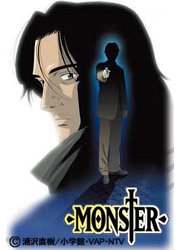
This is just a damn good show period. Live action or animation, this is one of the best, most well-thought-out stories I have seen in a TV show in quite a while. And as much as I tend to spit this phrase out, this, more than any other show, is the kind of thing anime fans show non-anime fans to prove that the medium can be mature enough for adults without necessarily being perverted, gratuitously violent, or pretentiously esoteric.

Dr. Tenma is a gifted brain surgeon from Japan who is working at a hospital in Germany. When a he is forced to make the decision to either operate on a mayor who would bring the hospital prestige, or the boy named Johan who came in first; Tenma follow his principles and saves the life of a boy, but the events that follow cause him to reconsider whether saving the boy was such a good idea.

There's a lot to like about this show, and I could go on an on about the haunting tone or the mysterious plot, but I'm mainly going to concentrate on how the show really distinguishes itself. That being that it is so realistic. I mean, this is the kindof thing that could have easily been done in live action, but is done effectively and beautifully in anime. There are two main reasons why I think this show looks so realistic: the level of detail and the characters.

First of all this story takes place in Germany after the fall of the Berlin Wall. A lot of references are made to before and after the Wall fell and how East Germany had all kinds of nasty projects going on. Basically there is a lot of historical detail that makes the show convincing because you have easy reference points for when all the different events took place. More than that though, there is also a lot of technical detail given for things like Temna's medical operations. And later on when Tenma trains for how to shoot a gun, his trainer gives him practical advice like "Make sure to shoot twice to double your odds of hitting the target." Other anime I've seen gets lazy in this area, and usually just resorts to generic terms like "Just try hard" or "do your best". So that level of detail really fleshes the story out and pulls you into the world of Monster by making it more convincing overall.

The second thing that makes this show engrossing is the characters. Each character is unique in both their designs and their personalities. You won't find any freakishly big-eyes, abnormally proportioned bodies, or oddly-colored hair here. Characters come in all shapes and sizes. And their peronalities and personal histories all fit the plot but also are convincing and sympathetic in and of themselves. One of my favorite characters, for instance, is the ever-calculating Inspector Lunge. He has this quirk where he will move his fingers eratically whenever he talks to someone. He says that it's his mnemonic technique that allows him to instantly recall anything he's ever heard. Sure it's odd, but it's better than saying that he simply has a photographic personality because it's something that add a lot of color to his character.

Having praised the show thus far, I will say that there are a couple things that may drive some people off. First, this show is almost totally driven by dialogue. That's not to say that it's slow paced, it's just that there's not a heck of a lot of action so those who are only entertained by constant action may be disappointed. Plus the show is very realistic, so people who prefer their fantasy to be more fantastical best look elsewhere.

The second thing that may turn some people off is that the plot can at times seem very contrived and even predictable. For instance, at the very beginning Tenma comes out of the operating room after having successfully operated on a very famous opera singer. He's faced with the wife of a man who arrived before the opera singer. She yelled at Tenma saying that he was the best surgeon in the hospital and that it was only fair that he should have operated on her husband who arrived first. This is an obvious set up for when the exact same situation comes up a couple days later with Johan and the mayor. That time Tenma makes the "right" choice, and so the story begins. There are quite a few moments like that where something happens or characters will meet and everything just happens to fit together nicely. Whenever a scene like that would come up I just kind of shook my head and moved on because, despite those contrivances, most of the story plays out logically and naturally.

The animation was great... or at least what there was of it was great. Like I said there wasn't a lot of action, so there wasn't much to judge the animation for. The art itself was consistently high-quality though, so I really have no complaints.

The music was awesome. I've been reading the manga version, which is nearly identical to the anime. But when comparing the two, the anime sticks out. The main reason being the music which is subtle and haunting, giving the story a deeper and darker tone without being obtrusive.

As with most everything else in this show, I loved the ending. The final story arc was tense and thrilling and satisfying because most all of the major characters got their moment in the sun. The very last scene was mysterious and I think ended the show on just the right note. It messes with your head just enough to leave you thinking about it for quite a while afterwards.

So all in all, I definitely recommend this show to everyone who likes a good story. I haven't seen anything like it before, and I would definitely welcome more like it in the future.

Friday, February 23, 2007

Best Opening Animation

It's been so long since I fist saw Record of Lodoss War: Chronicles of the Heroic Knight that I almost forgot how unbelievably gorgeous the opening animation is. And as far as I'm concerned, it's still the best. God, Yoko Kanno just kicks so much ass.

Sunday, February 18, 2007

Reading Journal: GTO (complete)

Manga Overview
Book Info

Rating:
Overall= B+
Story = B+
Art = B+
Translation = B

Journal

I've seen all the versions of GTO including the anime and the live action drama and movie, and I still think this manga version is the best. It includes a lot of material that's not covered in either TV series, bringing Great Teacher Onizuka even greater challenges from the class that has vowed to either get him fired or willingly quit, and the faculty that despises his nontraditional (if not downright insane) teaching methods. The plots against him get more and more insidious, culminating with the introduction of a new school head mistress who is hot but who also redefines the word b***h. But no matter how badly his situation spirals out of control, Onizuka is always able to turn it into some sort of life lesson for his students where he is able to make them see life in a whole different light.

This is probably the crudest version of GTO compared to the others (not that that's a bad thing). The anime was cleaned up a lot, removing the references to Onizuka's extensive porn collection as well as his extensive group former biker-gang buddies who are involved in all kinds of shady dealings from drug trafficking to ... well, I don't want to ruin it for you. The live action TV drama did include references to his video collection, but even then it didn't develop that side of Onizuka to the extent that the manga does.

Actually, Onizuka's perversion is an important aspect of the manga because, even though the other teachers are just as bad as he is, Onizuka is the only one who is honest about it. And it's the fact that he is an open book about everything that wins his students over in the end because they realize that if he's honest about that then he's honest about everything else he tells them.

That's not to say that it doesn't get him into a lot of trouble. In fact a lot of the plots that are hatched against him try to take advantage that he is a 22-year old virgin who is looking for "love". I mean, you know that he's going to win over his students in the end. That much is predictable. It's how he gets to that point that makes it hilarious and unpredictable. That's because it seems like almost everything he does is just to satisfy himself of to save his own butt. Still, no matter what he does he just seems to be making it worse for both himself and his students, but in the end he turns the situation into a lesson for his students.

The art in the manga was more realistic than you will find in your average manga. The characters all have distinct and believable designs. Sure there are some characters that are generously proportioned, but even then the designs are believable. Of course, the classic trademark of GTO is Onizuka's facial expressions -- they are realistic (I have to laugh just thinking of the author looking in the mirror as reference material) but ... well just check this out:


The end of the manga was much better than either the anime or live action drama. Both of those just have Onizuka leaving the school after his job is done. While the manga has probably the most over-the-top ending, it's much more satisfying and dramatic and, I think, fitting for GTO.

When I finished up the last volume it was kind of a bitter-sweet send-off. I know there's the Shonan Junai-Gumi manga (as well as Bad Company and the associated anime and live action versions) but that's not nearly as good as GTO so I'm really going to miss it. Sure this has some crass humor, but it's balanced by a lot of heart and comedy, all making for a fun and unpredictable story. If you haven't checked out GTO yet, go pick it up. All the versions are great, but the manga is still the best.

And just for the heck of it, here's the openings for the TV versions:

Thursday, February 08, 2007

Viewing Journal: Afro Samurai (complete)

Series Overview
TV Broadcast Info
DVD Info
Trailer

Rating:
Overall= B
Story = C
Video = A
Audio = C

Journal

I first heard about Afro Samurai in a random article back in 2003. Ever since then I've been itching to find out what the show would be like. So I finally got a chance to see it on Spike TV last month and I have to say that it met all of my expectations.

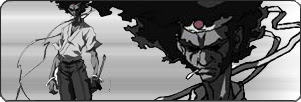
This was a great show because of one thing ... the visuals. A combination of the character designs and the excellent animation made for some thrilling action sequences. Sure there wasn't a lot to the storyline, but who cares when you get to see action of that degree.

The budget for production was reportedly $1 million per episode. Now I can't exactly say that it looks like it cost 1 mil, but still, I can't stress enough how dynamic everything looked. From the camera angels to the expressions of the characters, it was amazing just to watch.

Of course, you have to be able to stomach an inordinate amount of violence because there is plenty here to even rival even the Ninja Scroll movie. But it's all so stylized, and the character designs and pretty much the whole general concept of the anime is so unrealistic -- if not downright goofy -- that it's hard to take it all that seriously. I mean, at one point you have a samurai with a gigantic afro fighting another one with a giant teddy bear head. At times it even seems as if the show is intentionally mocking itself, because through all the goofiness, the characters -- with the exception of Afro's loudmouth sidekick -- maintain their sober, brooding tones.

As I mentioned before, you don't get an extremely deep story in these 5 episodes. The main plot is just and excuse to move Afro from one violent encounter to the next. And other than Afro -- and to an extent his side kick -- you don't learn a lot about any of the characters or their motivations, which is a shame. The "Clan of the Empty Seven" is the best example of something that could have benefited from more depth. Not that I'm complaining too much, because there's not much more that you can expect from a 5-episode series that concentrates on action -- at least not without sacrificing the cool action scenes.

One thing that I was curious about though, was how they revealed the origin of Afro's sidekick. The way it was revealed didn't make sense (i.e., how could Justice (aka, #1) know that's who he was) and I can't help but wondering if Justice's line was just thrown in to make it more obvious to US audiences. I wonder if that line will be included in the Japanese audio track considering that Japanese tend to prefer implied -- as opposed to direct -- explanations.

One other thing that I wanted to mention is how some people will probably compare this to Samurai Champloo -- the other anachronistic samurai anime. I wouldn't go so far as to call it a rip-off though, because Afro has much darker tone and more of a sci-fi edge to it.

Overall, this was a great show and I'll definitely be buying the unedited DVD when it comes out. But that being said, I probably wouldn't care whether or not Gonzo decided to make more episodes. The animation and character designs were incredible, but that can only take an anime so far before it becomes tiring. I read in an article that the original manga author developed something like 1000 years of background story, so if Gonzo develops that in future episodes (assuming that future episodes are developed at all) I'd be interested. But if they continue with just concentrate on visuals without more character or plot development then it'll loose it's charm fast.

Saturday, February 03, 2007

Viewing Journal: Kurau Phantom Memory (complete)

Series Overview
DVD Info (available April 10)
Trailer

Rating:
Overall= B
Story = B
Video = B
Audio = B+

Journal

I'm not exactly sure why, but this was an extremely hard show to review. I know I liked the show and I'd recommend it, and I'm pretty sure I know why I liked it, it's just that it's hard to put it into words. But I'll give it a try anyway...

First off, the show has an interesting and original concept. It starts out with a scientist named Dr. Amami who is performing an experiment to harness a new type of energy called Rynax energy. Something goes wrong in his experiment though, and as a result the body of his daughter -- Kurau -- is taken over by two energy entities of unknown origin, giving her super human abilities. Eventually Kurau's second energy entity manifests herself as a human whom Kurau names Christmas. When the government discovers their existence, they send out a special task force to eliminate them both.

What makes that whole concept so original isn't the plot itself -- there have been plenty of other stories about botched experiments giving rise to super powered humans. What makes this original is that it used that concept as a kind of allegory for human relationships. And as a result, it creates a surprising amount of empathy for the characters. Sure you may not be able to empathize with the characters' literal experience -- I mean how many of us have ever been possessed by an two alien energy entities, much less have one of them suddenly manifest itself as a separate human. But you probably can understand Kurau's loneliness and her subsequent happiness when she finds the one person she is meant to be with. The whole concept of "Rynax" and "Rynasapians" are used throughout the show to represent the themes of loneliness and companionship. And it works surprisingly well.

If I have one problem with the show it's that it doesn't give a lot of concrete technical explanation for what exactly the Rynax are. For instance you never lean why Rynax must always exist as a pair, or where exactly they came from, or how humans originally discovered their existence. The show only gives enough explanation so as to make the idea of Rynax work as a symbol for the human spirit, but it leaves the rest up to your imagination.

The last few episodes were kind of awkward. There's a final battle, but it's confusing because a lot of stuff happens that isn't explained until the next episode. The very end is satisfying from a character-development level, but again, I was still left wanting more explanation for what the Rynax were.

This show was animated by Studio Bones, which is responsible for such works as Wolf's Rain, RahXephon, and Fullmetal Alchemist. The studio isn't exactly revolutionary, but it is consistent. Most all of their shows have good quality animation throughout, and Kurau was no exception.

The music set the perfect mood for the show. Just listening to the opening (which I can't find on YouTube) and ending themes will give you a good idea of what to expect for the tone of the rest of the show.

So I'm not sure if I did the best explaining for what I liked about this show, but in the end I think it comes down to its ability to create empathy with the characters. Sure the science concepts are vague, and at times the story can get redundant (Kurau and Christmas are captured and escape like 3 times!), but I loved the characters and drama. The first DVD is going to be released in the US on April 10, so make sure to give it a try and see if you can explain it any better. ;)

Thursday, February 01, 2007

Nabeshin seen on Jeopardy!

My wife told me about this crazily dressed guy who was on Jeopardy yesterday. He returned today, and when I first saw him I instinctively shouted "Oh my God! It's Nabeshin!"

The contestant's actual name is Nate Metcalf but his outfit was the exact same as the director and self-animated character of Excel Saga! The only thing he was missing was the afro.


And for fans out there, here's the real nabashin in action. :D

Thursday, January 25, 2007

Le Chevalier D'Eon episode 1 -- Awesome!

Whoa! Production I.G. has topped themselves with Le Chevalier D'Eon. Story, music, and the animation. I haven't seen such a perfect mix since Ghost in the Shell. Just watch it.

You can watch the first episode here.

Friday, January 19, 2007

Save the date: May 25 for Paprika in US theatres

Paprika is coming to US theatres on May 25. Check out the website for a new trailer! (It looks like it might be the opening credits.)

Source: AnimeNation

Tuesday, January 16, 2007

Ghost in the Shell: LIVE ACTION

How many anime have we heard Hollywood making into live action movies? Monster, Evangelion, Battle Angel just to name a few. How many have we actual seen realized? None. So I'm not holding my breath for this one. Though the fact that Ghost in the Shell was one of the major influences behind the Matrix trilogy might help to generate some popular interest.

From Anime News Serivce:

Production I.G has announced they have secured a deal to act as an agent and actively begin putting things into place to make a Live Action Ghost In The Shell film come together in Hollywood, USA. The studio had to first work out a deal with creator Masamune Shiro and manga publisher Kodansha who owns the original rights to usage.

Wednesday, January 10, 2007

Death Note Licensed, To be available for download

From Anime New Service:

VIZ Media, LLC (VIZ Media), one of the entertainment industry's most innovative and comprehensive publishing, animation and licensing companies, has announced that it has licensed from Nippon Television Network Corporation (NTV) the Download to Own (DTO) and Download to Rent (DTR) rights for the United States for the smash hit DEATH NOTE anime series, currently airing in Japan.

The deal is significant because it marks the first time a well known Japanese anime property will be made legally available to domestic audiences for download to own while the title still airs on Japanese television. VIZ Media will seek to make the series available to consumers through a number of online providers in order to reach the widest audience possible.

Noir / Madlax sequel: El-Cazador

From Anime News Service:

Scheduled to begin broadcast in April, 2007 is the El-Cazador anime TV series. Confirmed staff include Dirtector: Koichi Mashimo (Noir, Eat Man, .Hack), Character Designs: Yoko Kikuchi (Noir), Series Composition: Kanemaki Kenichi (Jigoku Shoujo), Music: Yuki Kajiura (Noir, Eat Man, . Hack), Animation Production: Bee Train. Official Site: http://www.elcazador.tv/.

The story centers on characters Ellice and bounty hunter Nadi. Following Noir and Madlax, this will be the third installment in a series of what Director Koichi Mashimo has referred to as his girls-with-guns genre trilogy. Look for spreads and images in the current crop of anime magazines making their way into Japanese retail outlets this next week.

Tuesday, January 02, 2007

Afro Samurai - First episode available Now!

Can't wait until Thursday to catch the first episode of Afro Samurai? You can watch it right now on the official website.

Source: The Anime Blog

Afro